







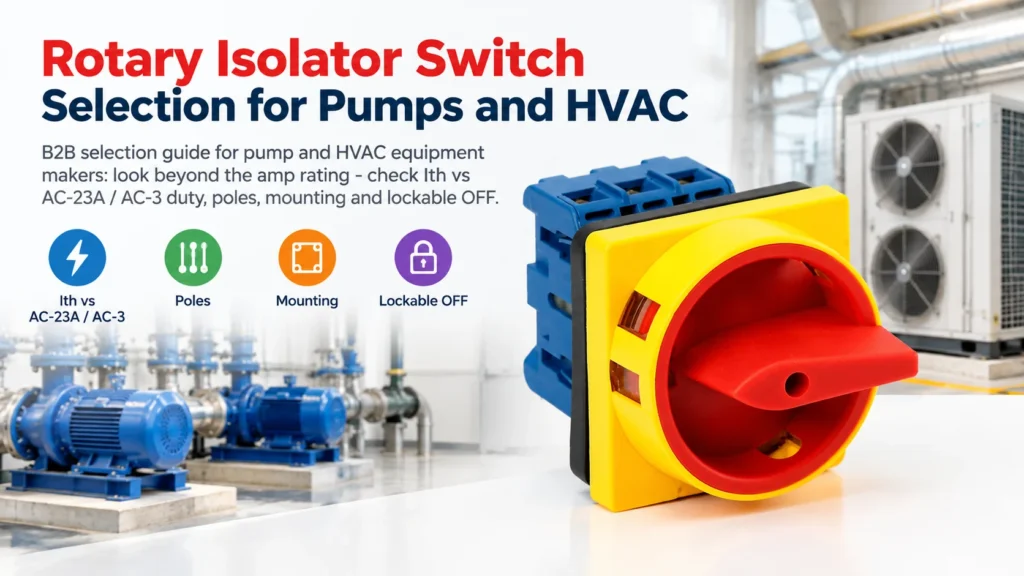
A pump panel needs a disconnect, and the purchasing list says “32 A rotary isolator switch.” That sounds specific, but it leaves out the operating voltage, switching duty, pole arrangement, and installation format. Even the meaning of 32 A needs checking against the technical table.
For equipment manufacturers and panel builders, the useful specification describes both the load and the installation. This guide uses Cantak’s published LW30 data to show how to read the ratings, narrow the configuration, and prepare a practical pump or HVAC enquiry.
Why a 32 A Switch May Have a Lower Motor-Duty Rating
Begin with the row labels. Rated thermal current, Ith, describes current-carrying performance under specified thermal conditions. Rated operational current, Ie, is associated with a defined voltage and utilization category. A motor-duty rating cannot be inferred from Ith alone.
For example, the Cantak LW30 catalogue, printed page 29, separates thermal current from AC-23A and AC-3 ratings. The following values are transcribed from its 440 V columns.
| LW30 model | Ith | AC-23A at 440 V: Ie / power | AC-3 at 440 V: Ie / power |
|---|---|---|---|
| LW30-20 | 20 A | 11 A / 5.5 kW | 7.5 A / 3.7 kW |
| LW30-32 | 32 A | 22 A / 11 kW | 15 A / 7.5 kW |
| LW30-40 | 40 A | 30 A / 15 kW | 22 A / 11 kW |
These are published LW30 catalogue values, not LW30B ratings. They illustrate how to read the table; confirm the current datasheet for the exact configuration supplied. Use the column for the project’s voltage, and assess both current and the manufacturer’s stated motor-power guidance.
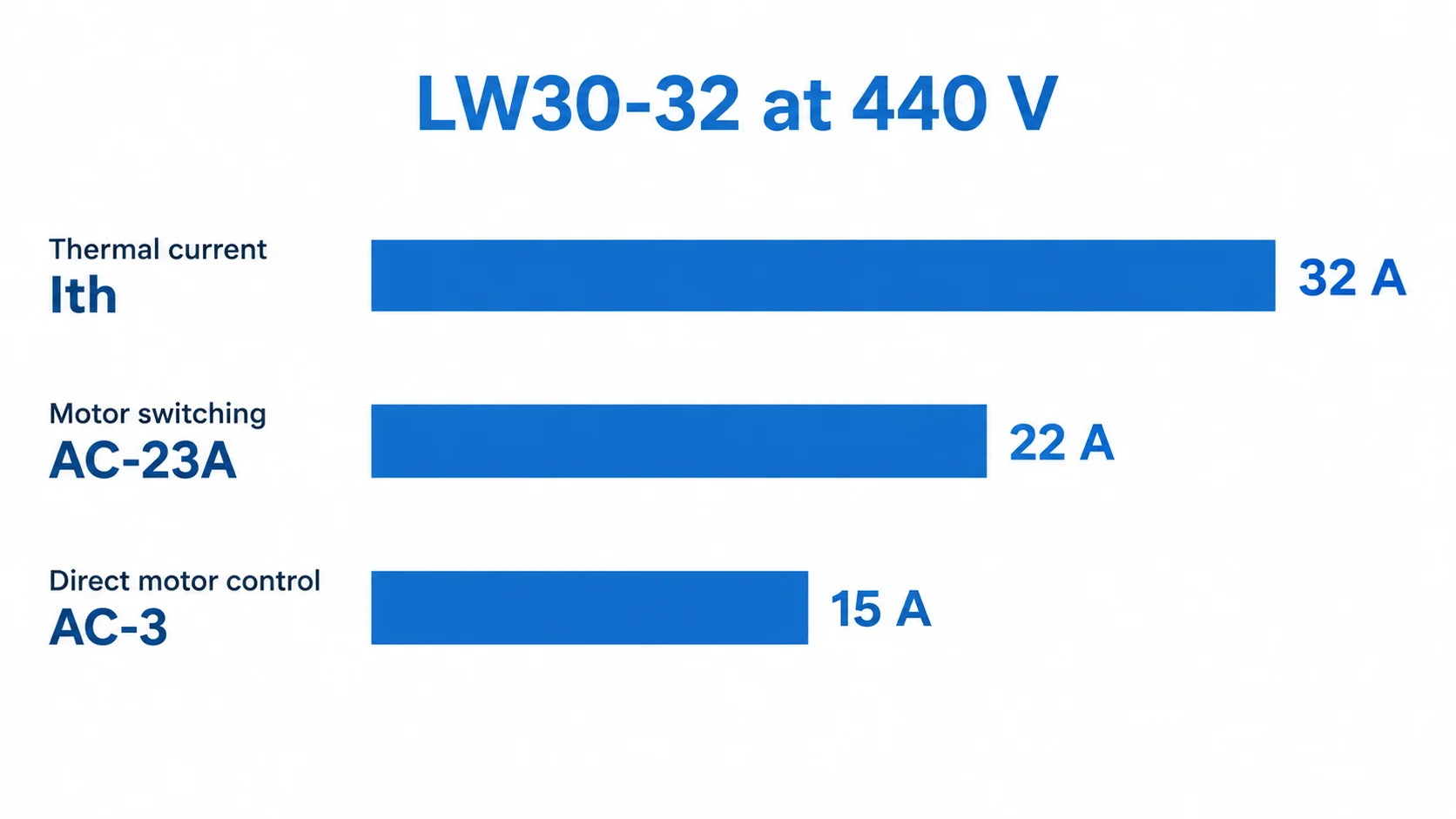
The difference matters: LW30-32 is listed with Ith of 32 A, but its published 440 V AC-23A operational current is 22 A. Its AC-3 operational current is lower again. Treating all three figures as “32 A capacity” would lose the duty information.
Decide Whether You Need Isolation or Direct Motor Control
A pump operated through a contactor may use a local rotary isolator switch for disconnection during servicing. A different design may use the switch to start and stop the motor directly. Specify which arrangement you have before selecting the rating.
| Declared duty | Information to check |
|---|---|
| Disconnection after normal shutdown | Suitability for isolation, required conductors, locking, and any load-breaking duty required by the design |
| Motor-load switching | Applicable AC-23A rating at the operating voltage and expected switching conditions |
| Direct starting and stopping | Declared motor-control duty, such as the manufacturer’s applicable AC-3 data, and operating frequency |
AC-23 concerns motor or other highly inductive load switching under IEC 60947-3. AC-3 describes squirrel-cage motor starting and switching off a running motor. Similar-looking power figures under these headings are not interchangeable ratings. State the intended operating sequence so the supplier can check the correct duty.
A control-panel HAND–OFF–AUTO selector serves another purpose: it selects a control path. Turning it to OFF does not necessarily disconnect the equipment’s power supply.
A Worked Comparison: A 440 V Pump Load
Assume an illustrative project has a 440 V three-phase pump load of 24 A, and its designer has specified AC-23A switching duty. This is a rating-comparison exercise, not an installation recommendation.
From the table above, LW30-32 does not meet that current criterion because its published Ie is 22 A. LW30-40, at 30 A, is a candidate for further checking. It has not yet been selected: motor power, operating frequency, ambient conditions, protection coordination, and the isolation arrangement still need assessment.
If the requirement instead includes direct motor starting assessed against the listed AC-3 duty, LW30-40’s 22 A figure would also be below the illustrative 24 A load. Changing the duty changes the comparison, even though the supply and product remain the same.
Specify the Poles and Auxiliary Functions Separately
The LW30 and LW30B product family is relevant to ventilation, air-conditioning, and water-pump applications. Cantak’s LW30 ordering section distinguishes pole count, additional contacts, neutral terminal, earthing terminal, and installation method.
Do not combine those options into a vague request for a “four-terminal switch.” A main switched pole, an auxiliary contact, and a connection terminal perform different jobs. Define each from the equipment schematic.
For packaged HVAC equipment, establish whether neutral-fed controls or auxiliary loads are present. Neutral switching follows the system design and applicable requirements. Protective earth must remain continuous; an earthing terminal is not a switched power pole.
Match the Mounting to the Equipment
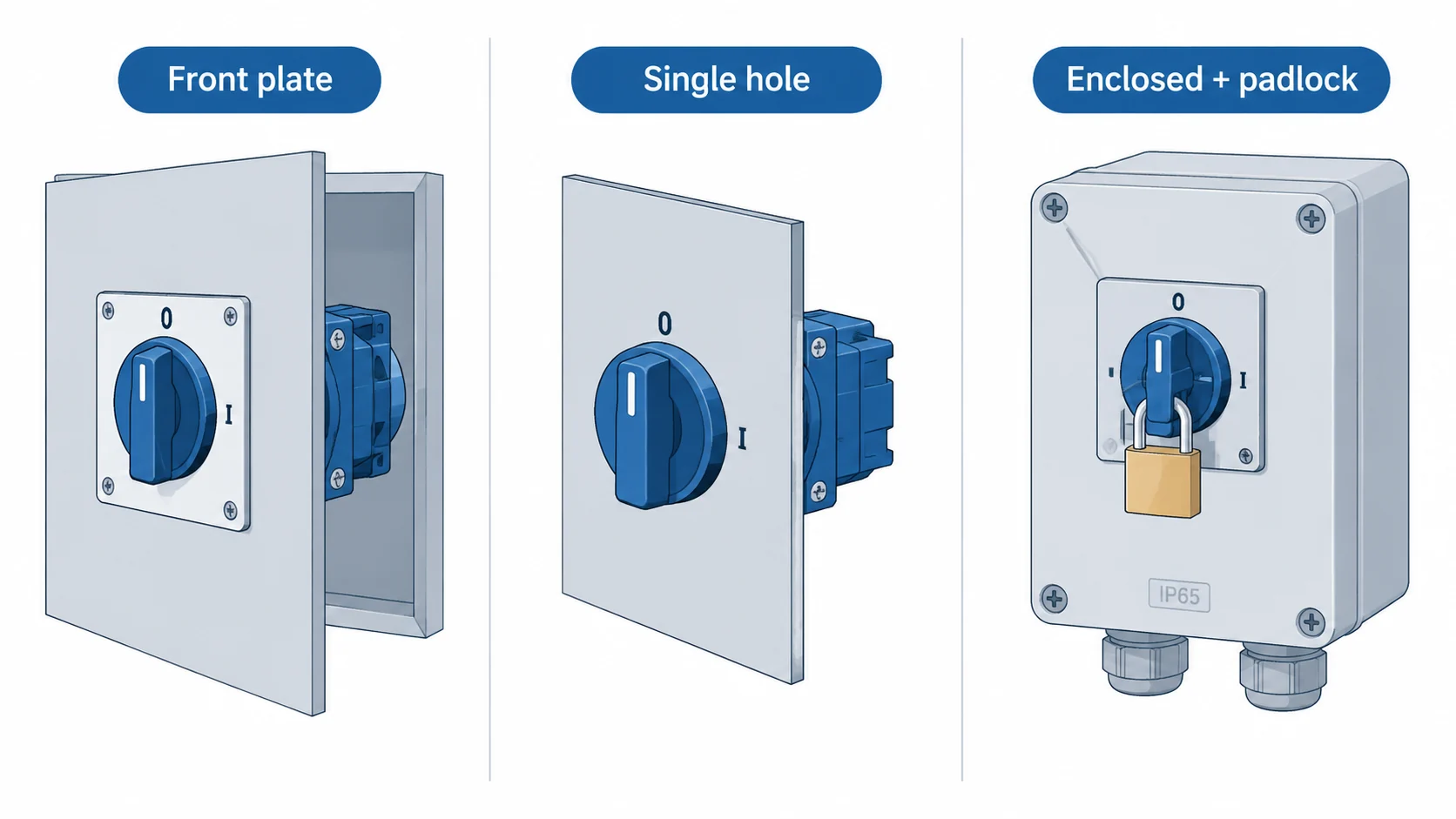
Cantak’s LW30 catalogue includes front-plate, base, and single-hole installation drawings, along with padlock and enclosure options. Select the complete assembly rather than choosing a switch body and assuming the handle will fit later.
| Location | Specify before ordering |
|---|---|
| Local pump disconnect | Enclosure, cable-entry arrangement, accessible operating position, and padlock clearance |
| HVAC control-panel door | Mounting holes, panel thickness, rear clearance, handle arrangement, and any door-interlock requirement |
| Base-mounted assembly | Operating hardware, shaft arrangement where used, enclosure depth, and alignment |
Dimensions become particularly important during replacement. Two switches with acceptable electrical ratings can still require different panel cut-outs or space behind the door.
Check the Enclosure and Lockable OFF Configuration
The LW30 catalogue lists an IP65 plastic-box option. That rating applies to the specified enclosed arrangement; it should not be assigned automatically to every bare or panel-mounted switch.
For outdoor HVAC equipment or damp pump locations, describe water exposure, sunlight, temperature, and cleaning conditions. An ingress rating does not by itself establish chemical or UV resistance, and the installed protection depends on cable entries and seals.
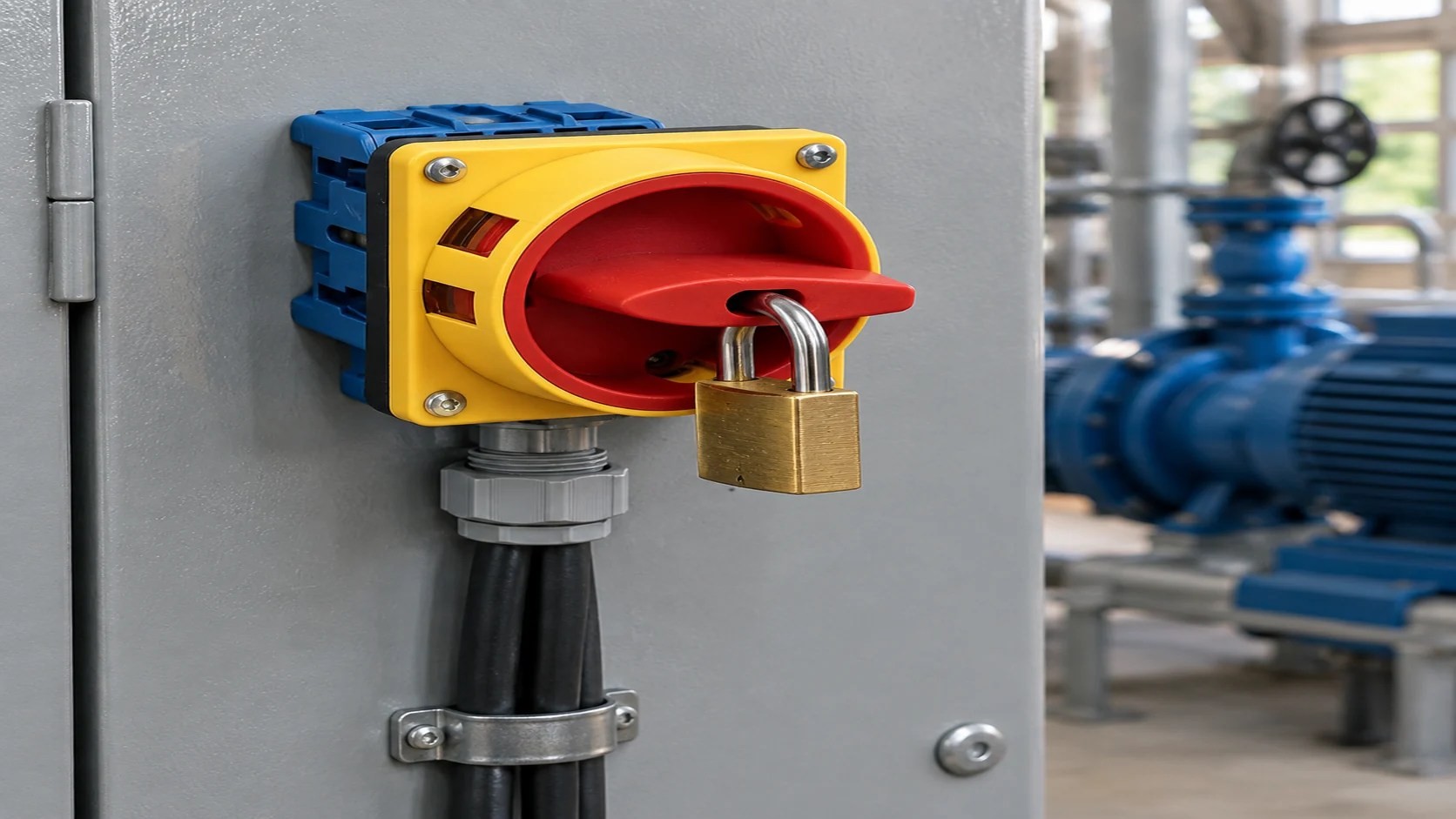
If servicing requires lockout, specify locking in OFF and confirm compatible padlocks. A general locking feature, or a red handle on a yellow plate, does not establish the complete isolation function. The maintenance procedure must address all supplies and stored energy.
A Better Enquiry for a Standard LW30 Switch
Most standard-product enquiries can start with the following short specification:
- Equipment and supply: pump, fan, or packaged HVAC unit; voltage, frequency, phases, and nameplate details.
- Duty: maintenance disconnection, load switching, or direct motor operation; expected switching frequency.
- Circuit: required main poles and separately defined auxiliary, neutral, and earth connections.
- Installation: mounting drawing, enclosure format, available space, and environmental conditions.
- Locking and quantity: lockable OFF requirements, order quantity, and any required product approvals.
Keep the circuit’s overload and short-circuit protection in the design. A standalone rotary isolator switch does not replace those protective devices. For wiring considerations after selection, use the exact product drawing together with Cantak’s three-phase isolator switch wiring guide.
Frequently Asked Questions
Can I select an isolator by motor kW alone?
No. Use the specified voltage and duty, check the motor’s actual current, and verify the complete application. A power figure in the wrong voltage or utilization-category column can lead to the wrong comparison.
Can LW30 ratings be used for LW30B?
Use the datasheet for the exact series and model. Do not transfer a value just because the products appear on a shared page.
Does a lockable handle make the equipment safe to service?
It can support an appropriate isolation arrangement, but it does not establish that every energy source has been isolated. Follow the equipment’s verified energy-control procedure.
Choose by Duty, Then Confirm the Configuration
A suitable rotary isolator switch matches the electrical duty, mounting, enclosure, and maintenance requirements. The published LW30 table shows why the series current is only the starting point.
Preparing a pump or HVAC order? Send Cantak your equipment nameplate, switching duty, circuit schematic, installation requirements, and quantity to discuss a standard configuration.