


A star delta switch changes a six-terminal motor from star to delta while it is running up, so that the motor starts on a reduced voltage and then runs on full voltage. In star each winding sees phase voltage; in delta each winding sees line voltage. That single change is what drops the starting current, and it is also what limits the switch to motors that are wound for it.
The switch is only part of the arrangement. A star delta start needs a transition that happens at the right speed, in the right order, with a break before the second connection is made. Get the switch right and the transition wrong, and the motor still starts badly.
Why a Motor Starts in Star
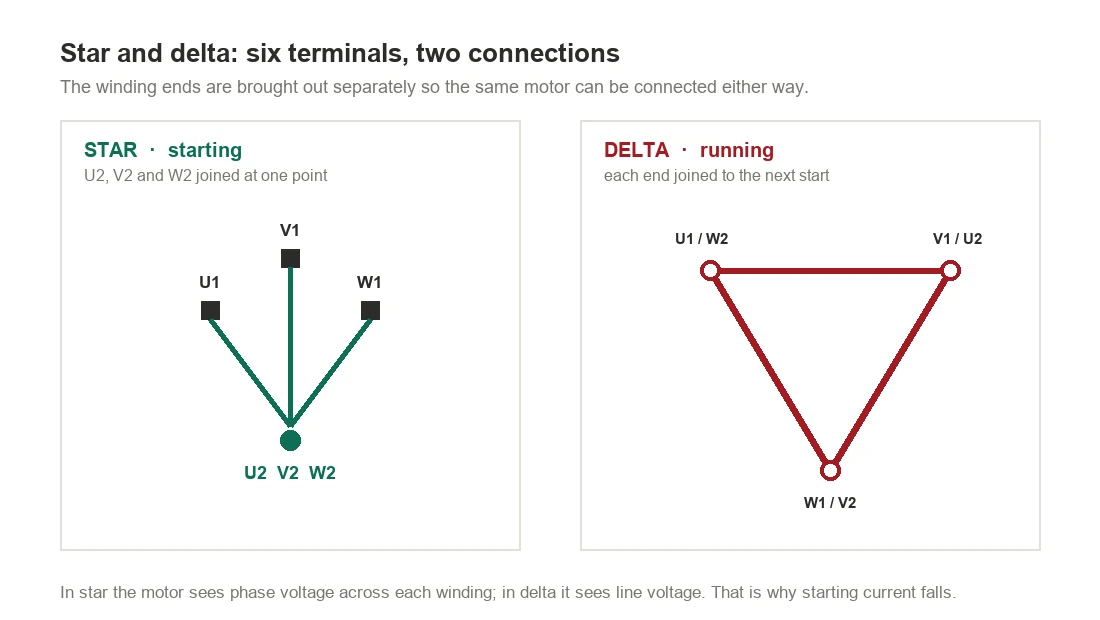
A six-terminal motor brings both ends of each winding out to the terminal box: U1, V1, W1 at one end and U2, V2, W2 at the other. That arrangement is what makes star delta possible at all, because it lets the three windings be connected in either configuration without opening the motor.
In star, U2, V2 and W2 are joined at a common point. Each winding then sits between one line and the star point, so it sees the phase voltage of the system — about 230 V on a 400 V supply. In delta, each winding sits between two lines and sees the full line voltage of 400 V.
| Star (starting) | Delta (running) | |
|---|---|---|
| Voltage across each winding | Line voltage ÷ √3, about 230 V | Line voltage, 400 V |
| Starting current | About one third of direct-on-line | Full direct-on-line current |
| Starting torque | About one third of direct-on-line | Full torque |
| Where it is used | Run-up only, a few seconds | Continuous running |
Both current and torque fall to roughly a third, which is the trade-off. Star delta is only suitable where the load can be accelerated with a third of full torque — fans, pumps, compressors and similar loads that start unloaded or lightly loaded. A motor that has to start against full load will simply stall in star and never reach the transition speed.
What the Switch Connects in Each Position
A three-position star delta switch has six output terminals and a set of changeover contacts. In position 1 it connects the supply to U1, V1 and W1 and joins U2, V2 and W2 together. In position 0 everything is open. In position 2 it keeps the supply on U1, V1, W1 and reconnects the second set of ends so that each winding is bridged to the next: U2 to V1, V2 to W1, W2 to U1.
| Position | Supply to | U2 / V2 / W2 | Winding voltage |
|---|---|---|---|
| Star (1) | U1, V1, W1 | Joined together at a star point | Phase voltage |
| Off (0) | Open | Open | None |
| Delta (2) | U1, V1, W1 | Bridged to V1, W1, U1 respectively | Line voltage |
That bridging pattern is the part that gets miswired. In delta, U2 does not join V2 — it joins V1. The three ends are cross-connected, not star-connected, and connecting them in the wrong order produces either no rotation or a short through the windings.
Star Delta Switch or Star Delta Starter?
The switch and the starter do the same electrical job by different means, and they suit different panels.
| Star delta switch | Star delta starter (contactors) | |
|---|---|---|
| Transition | Manual, operator-timed | Automatic, timer or current relay |
| Interlock | Mechanical, in the switch | Electrical and mechanical, between contactors |
| Repeatability | Depends on the operator | Consistent |
| Remote control | No | Yes |
| Best for | Small motors, local control, occasional starting | Production equipment, unattended plant |
A manual star delta switch depends on the operator judging when to move the handle, and that judgement is the weak point. Too early and the motor stalls or draws a second surge; too late and the motor has already accelerated on reduced torque, which wastes the start. The switch is appropriate for small motors where a person is standing at the panel; anything automatic wants a contactor starter.
The Changeover Must Break Before Make
The transition from star to delta must break before make. If the incoming delta contacts close while the star point is still connected, two lines are shorted together through the star point and the resulting current is limited only by the supply impedance.
This is why a star delta switch has a defined off position in the middle rather than a simple changeover. The sequence is: open the star point, wait for the arc to clear, then close delta. A cam switch achieves that mechanically; a contactor starter achieves it with a timer and an interlock so that the star contactor has dropped out before the delta contactor picks up.
The same reasoning explains why a star delta switch can never be replaced by a changeover switch. A changeover has the same three positions, but its contact sequence is built for two sources feeding one load, not for reconfiguring three windings. The bridging pattern is different, and in a changeover the middle position may not open all six terminals.
When to Change Over
The motor should reach roughly 75 to 80 percent of its running speed before the transition. At that point the current has fallen enough that the delta connection does not produce a second large surge, and the torque available in delta is enough to finish the acceleration.
In practice that is a timer setting of a few seconds for most small and medium motors, adjusted on site by watching the current. A current relay does the job more directly: it measures the motor current in star and initiates the transition when the current has fallen to a set fraction of the starting value.
Two failure modes are worth knowing. Transition too early produces a current spike almost as large as a direct-on-line start, which defeats the purpose. Transition too late means the motor has been running in star for longer than it should, and a motor that is still accelerating in star is drawing more current than its star rating allows.
Sizing and Wiring the Switch
- Confirm the motor is wound for it. The nameplate must show a delta connection at your line voltage, typically 400 V delta / 690 V star. A motor marked 230 V delta / 400 V star cannot be star-delta started on a 400 V supply.
- Check the terminals are all brought out. Six terminals in the box, with the links removed. A motor with three terminals only cannot be reconfigured.
- Size on the motor rating at the supply voltage, in the motor utilisation category, not on the thermal current.
- Land U1, V1, W1 on the supply side and U2, V2, W2 on the star point side, keeping the order consistent so that the delta bridges fall in the right places.
- Prove the sequence with a meter before energising: star position should show continuity between U2, V2 and W2, and delta position should show continuity between U2 and V1, V2 and W1, W2 and U1.
- Test with the driven load disconnected the first time, and confirm the direction in star before trusting the transition.
If the motor runs backwards, swap two supply phases at the incoming terminals. Swapping at the winding ends changes the star point and the delta bridges at the same time, which is much harder to reason about afterwards.
One more point on the switch itself: a star delta switch is a load-break device, and it is opened under current every time the motor is started. That is a different duty from an isolator, which may only ever be opened with the circuit dead. The utilisation category on the nameplate tells you which you have, and a switch bought on thermal current alone may be the wrong one for a duty where it breaks starting current several times a shift.
Manual star delta also has a practical limit on motor size. Above roughly 30 kW the starting current and the arc energy make a hand-operated transition unpleasant to use and hard on the contacts, which is why contactor starters take over at that point. Below it, a switch is compact, needs no control wiring and gives the operator a visible position.
Mistakes That Stop a Star Delta Start Working
- Motor not suitable for star delta. A 400 V delta motor on a 400 V supply is the requirement; a 230 V delta motor connected in star on 400 V runs at the wrong flux and overheats.
- Delta bridges landed in star order. U2 to V2 instead of U2 to V1 produces a motor that does not rotate or draws locked-rotor current in delta.
- Transition without a break. The star point and the delta bridge closed at the same time short two lines together.
- Transition too early. The current surge is nearly that of a direct-on-line start, and the reduced-voltage start achieves nothing.
- Using a changeover switch. It has three positions but not the right contact pattern, and the middle position may not open every terminal.
FAQ
What does a star delta switch do?
It connects a six-terminal motor in star for starting and then reconnects it in delta for running, reducing the starting current to about one third of a direct-on-line start.
Why does star delta reduce starting current?
In star each winding sees phase voltage rather than line voltage, about 58 percent of it, so the current through each winding falls to about a third. Torque falls in the same proportion.
Can any motor be star-delta started?
Only a motor with six terminals brought out and a delta rating that matches the supply voltage. A motor wound for 230 V delta cannot be star-delta started on a 400 V supply.
When should the switch change from star to delta?
At roughly 75 to 80 percent of running speed. In practice that is a timer setting of a few seconds, or a current relay that trips the transition when the starting current has fallen.
Can I use a changeover switch for star delta?
No. A changeover switch has three positions but a different contact pattern, built for two sources feeding one load. Star delta needs the windings cross-connected in delta and joined at a star point in star.
What happens if the switch changes over too early?
The motor has not accelerated far enough, so the delta connection produces a current surge close to a direct-on-line start, and the motor may stall instead of accelerating.
Does a star delta switch need an interlock?
The switch has a mechanical interlock that forces the handle through the off position. A contactor-based starter needs an electrical interlock between the star and delta contactors as well as a timer.
Is star delta still used on modern installations?
Yes, on pumps, fans and compressors where the load starts lightly. Electronic soft starters and drives have replaced it on many new installations, but a very large number of existing panels still use star delta.
Match the Switch to the Winding
A star delta switch is a simple device that only works when the motor, the terminal arrangement and the transition are all correct. The switch itself is rarely what fails; the delta bridges or the timing usually are.
The star delta configuration is available on the LW26 series and the LW40 series, alongside the reversing and changeover arrangements, and the full range is on the rotary switch and isolator pages. If you are choosing between a switch and a contactor starter, the rotary switch types selection guide covers how the contact arrangements differ, and the cam switch mechanism explains how the sequence is set inside the switch.
Send us the motor nameplate, the supply voltage and whether the start is manual or automatic, and we will confirm whether the motor can be star-delta started at all before quoting a switch.