







LW40 Series
Rotary Cam Switch
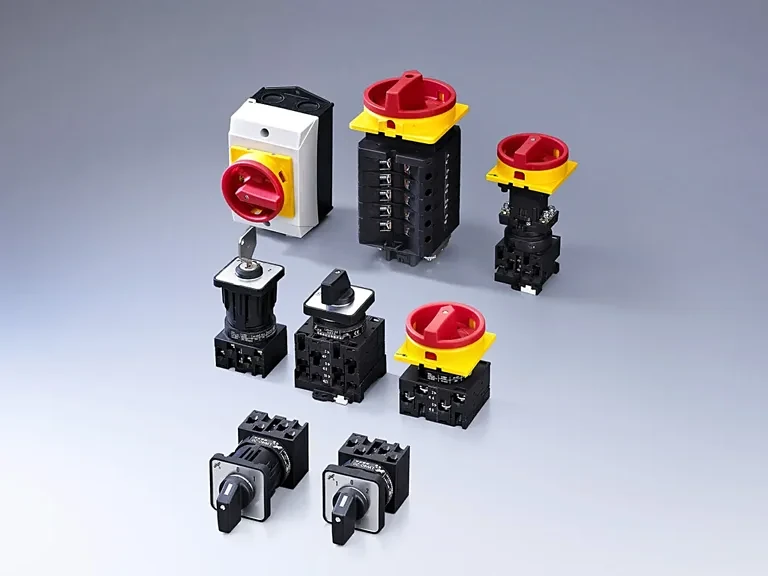
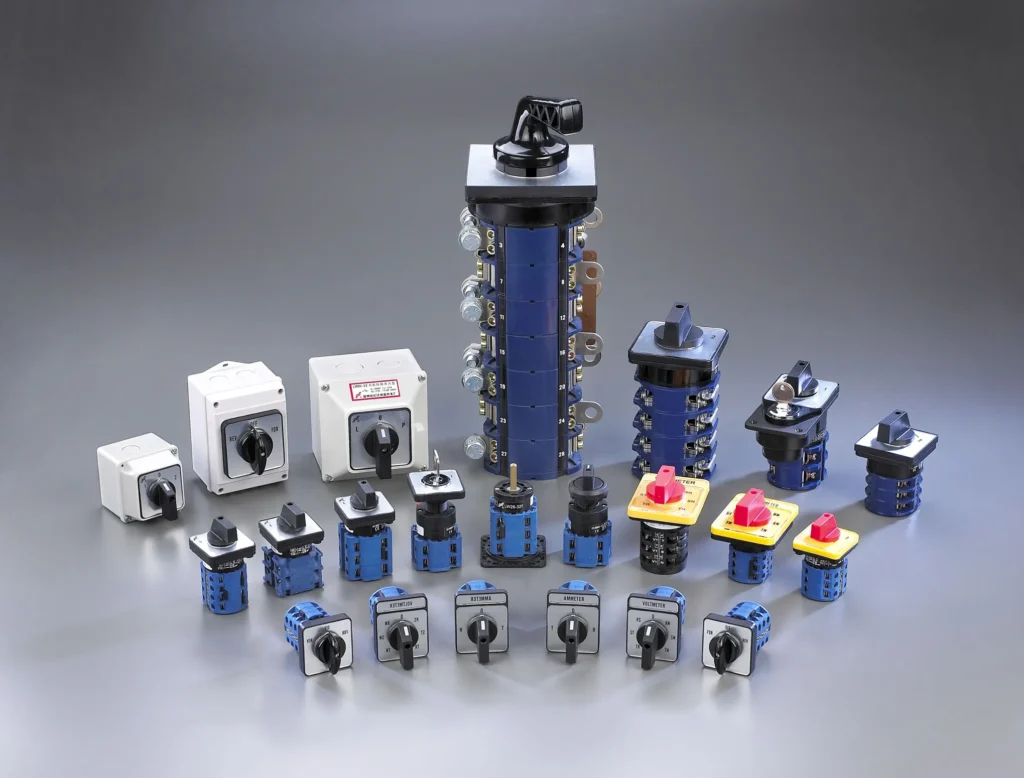
A compact rotary cam switch built for numerical control machines and machine tool cabinets. One to four contact layers in a single body, twenty-two rotation angle codes from A to Z, and four mounting types — control, illumination, protection and measurement from one switch.
What The LW40 Rotary Cam Switch Covers
The LW40 rotary cam switch applies to AC 50 Hz circuits up to 690 V and to DC circuits up to 440 V. In one housing it combines four jobs that would otherwise take four components — to control, to illuminate, to protect and to measure — which is why it is the standard selector in numerical control machine cabinets.
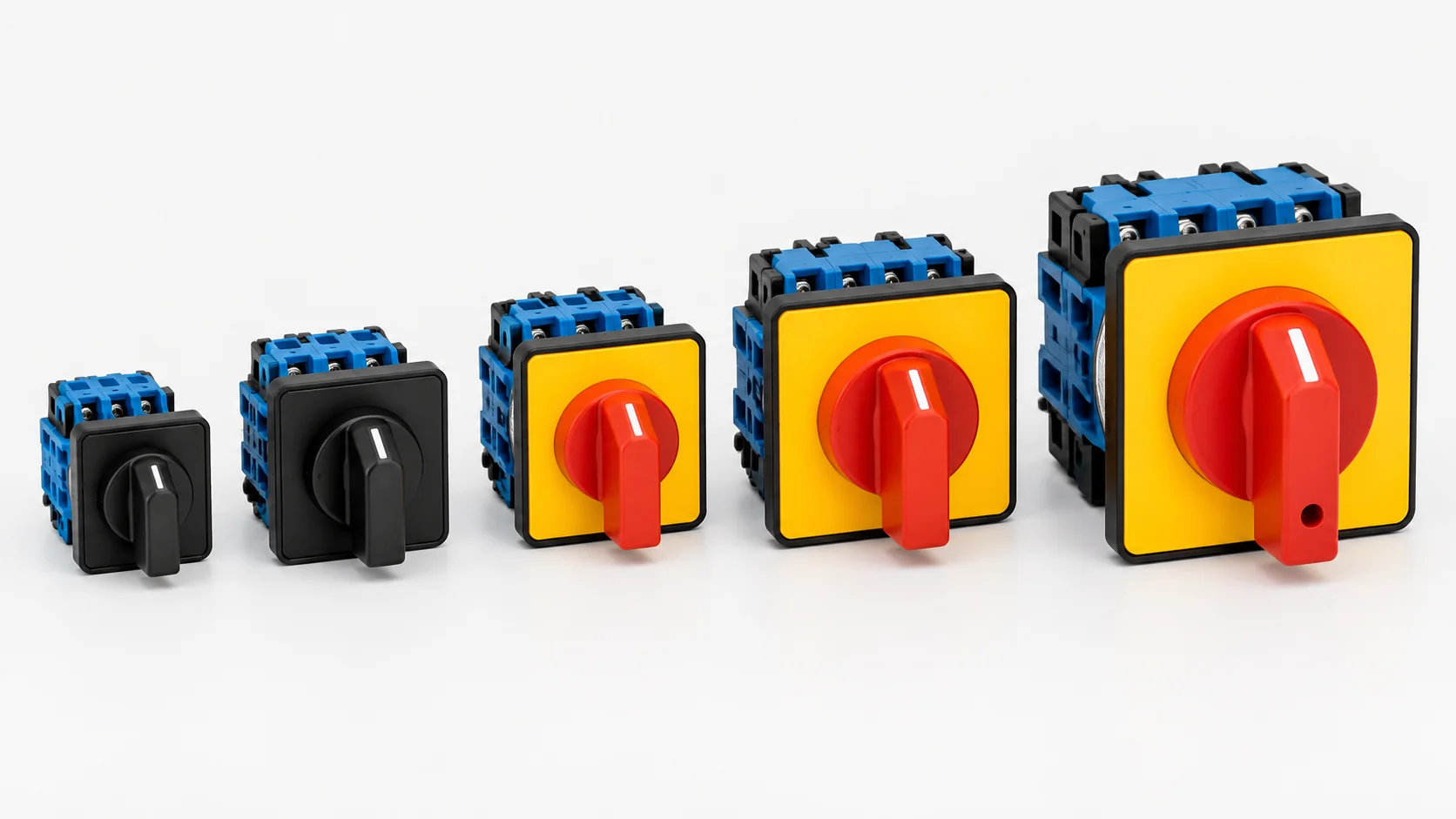
Three current ratings are available: 20 A, 25 A and 32 A. The body can be built with one to four contact layers, and each layer carries its own contact block and its own switching angle, so a four-layer unit can run four independent functions from one handle.
Switching behaviour is not described in words but in a single letter. Codes A and B spring the handle back when released, codes C to R stay where they are set, and the mixed codes Q, S, W and Z hold some positions while springing back from others. The full A–Z matrix is on this page.
The body grows with the layer count, so the catalogue writes the length as a formula rather than a fixed number: L = 37 + 9.5n for the 20 A plate version and L = 38 + 11.5n for the 25 A and 32 A versions, where n is the number of layers. Tell us the layer count and we return the exact drawing for your panel cut-out.
For projects that need the machine locked in a defined mode, the same body is offered with a key-lock cylinder or with a pad-lock that fits straight onto the switch. Every export batch ships with a dimension drawing and a routine test record, and the angle code is confirmed in writing before production starts.

Four Mounting Options For A Rotary Cam Switch
All four mounting types use the same contact block, so the switching behaviour never changes with the mounting. Plate installation takes a 1–5 mm panel; the key and pad-lock versions lock the machine in a defined position.

Escutcheon Plate
1–5 mm panel · L = 37 + 9.5n
Single Hole
φ22.3 mm hole · L = 57 + 9.5n
Key Lock
Key cylinder · panel depth 68 mm
Pad-lock
Lock shackle visible · depth 36 mmNeed a fifth mounting, a printed legend or a longer shaft for a deep panel door? Send us the drawing
Not sure whether you need the plate, the single hole or the key version? Send the panel drawing — we reply with the model and the full angle code.
Choosing The Right Rotary Cam Switch
Three rated sizes, each available in one to four layers. AC-23A is the mixed inductive load rating and AC-3 the squirrel-cage motor rating — check both against the motor plate before you pick the size.
| Description | LW40-20 | LW40-25 | LW40-32 |
|---|---|---|---|
| Rated thermal current Ith | 20 A | 25 A | 32 A |
| Rated working voltage Ue | 440 V | 440 V | 440 V |
| Rated working current, AC-23A | 15 A | 20 A | 25 A |
| Rated working current, AC-3 | 11 A | 15 A | 18 A |
| Number of layers | 1 to 4 | 1 to 4 | 1 to 4 |
| Body length, plate version | L = 37 + 9.5n | L = 38 + 11.5n | L = 38 + 11.5n |
| Body length, single hole | L = 57 + 9.5n | L = 58 + 11.5n | L = 58 + 11.5n |
Rotation Angle Codes A – Z
Every switching behaviour is written as one letter. Three operating modes are used: auto-reset (the handle springs back), location (the handle stays where it is put) and mixed (some positions are held, others spring back). Read the column that matches your layer count.
| Code | Operating mode | Layer 1 | Layer 2 | Layer 3 | Layer 4 |
|---|---|---|---|---|---|
| A | Auto-reset | 0°-30° | 0°-45° | 0°-60° | 0°-90° |
| B | Auto-reset | 30°-0°-30° | 45°-0°-45° | 60°-0°-60° | 90°-0°-90° |
| C | Location | 0° 30° | 0° 45° | 0° 60° | — |
| D | Location | 30° 0° 30° | 45° 0° 45° | 60° 0° 60° | — |
| E | Location | 30° 0° 30° 60° | 45° 0° 45° 90° | 60° 0° 60° 120° | — |
| F | Location | 60° 30° 0° 30° 60° | 90° 45° 0° 45° 90° | 60° 0° 60° 120° 180° | — |
| G | Location | 60° 30° 0° 30° 60° 90° | 90° 45° 0° 45° 90° 135° | 120° 60° 0° 60° 120° 180° | — |
| H | Location | 90° 60° 30° 0° 30° 60° 90° | 135° 90° 45° 0° 45° 90° 135° | — | — |
| I | Location | 90° 60° 30° 0° 30° 60° 90° 120° | 135° 90° 45° 0° 45° 90° 135° 180° | — | — |
| J | Location | 120° 90° 60° 30° 0° 30° 60° 90° 120° | — | — | — |
| K | Location | 120° 90° 60° 30° 0° 30° 60° 90° 120° 150° | — | — | — |
| L | Location | 150° 120° 90° 60° 30° 0° 30° 60° 90° 120° 150° | — | — | — |
| M | Location | 150° 120° 90° 60° 30° 0° 30° 60° 90° 120° 150° 180° | — | — | — |
| N | Location | — | 45° 45° | 30° 30° | — |
| P | Location | — | — | — | 90° 0° 90° |
| Q | Mixed | 30° 0°-30° | 45° 0°-45° | — | — |
| R | Location | — | — | — | 270° 0° 90° 180° |
| S | Mixed | 30° 0° 60° | 90° 0°-45° | — | — |
| T | Location | — | — | — | 0° 90° |
| V | Location | — | — | — | 90° 0° |
| W | Mixed | — | 90° 45° 0° 45°-90° | — | — |
| Z | Mixed | 120°-90° 0°-30° | 135° 90° 0°-45° | — | — |
No letter in mind? Describe the switching sequence — we select the code, or propose a customised programme instead. Send the sequence
Where A Rotary Cam Switch Is Used
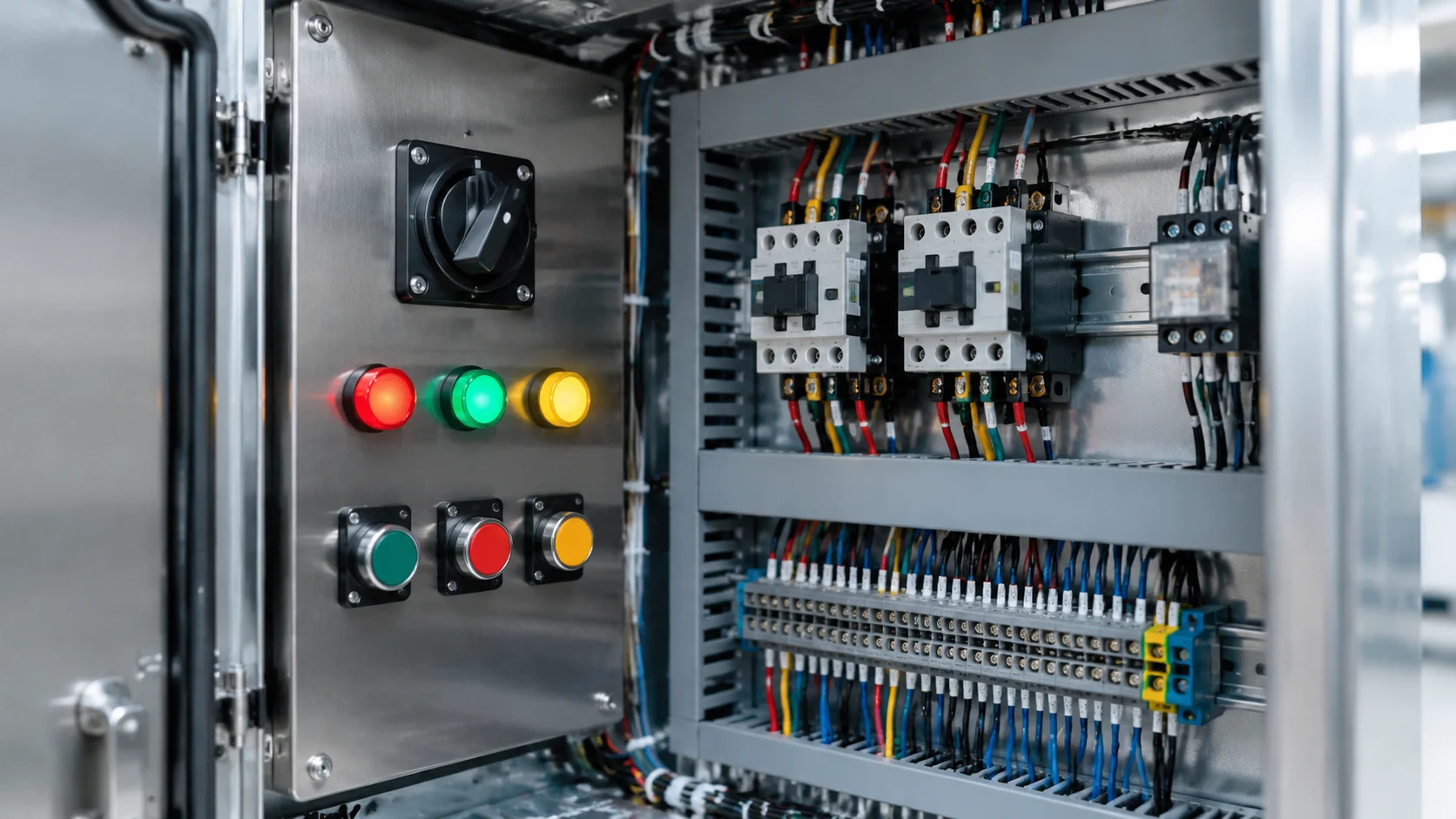
The catalogue names numerical control machines as the core application, then illumination, protection and measurement. In all of them the switch is the part of the panel the operator actually turns.
Numerical control machines
Mode selection and auxiliary functions in one body. A four-layer unit switches four circuits from one handle, which is why the LW40 is short enough to sit beside the contactors rather than behind the door.

Machine illumination and small motors
Lighting circuits and small squirrel-cage motors are switched from the same panel. AC-3 rating is 11 A, 15 A and 18 A for the 20 A, 25 A and 32 A sizes, so a 0.75 kW to 7.5 kW motor can be started directly.
Protection and measurement panels
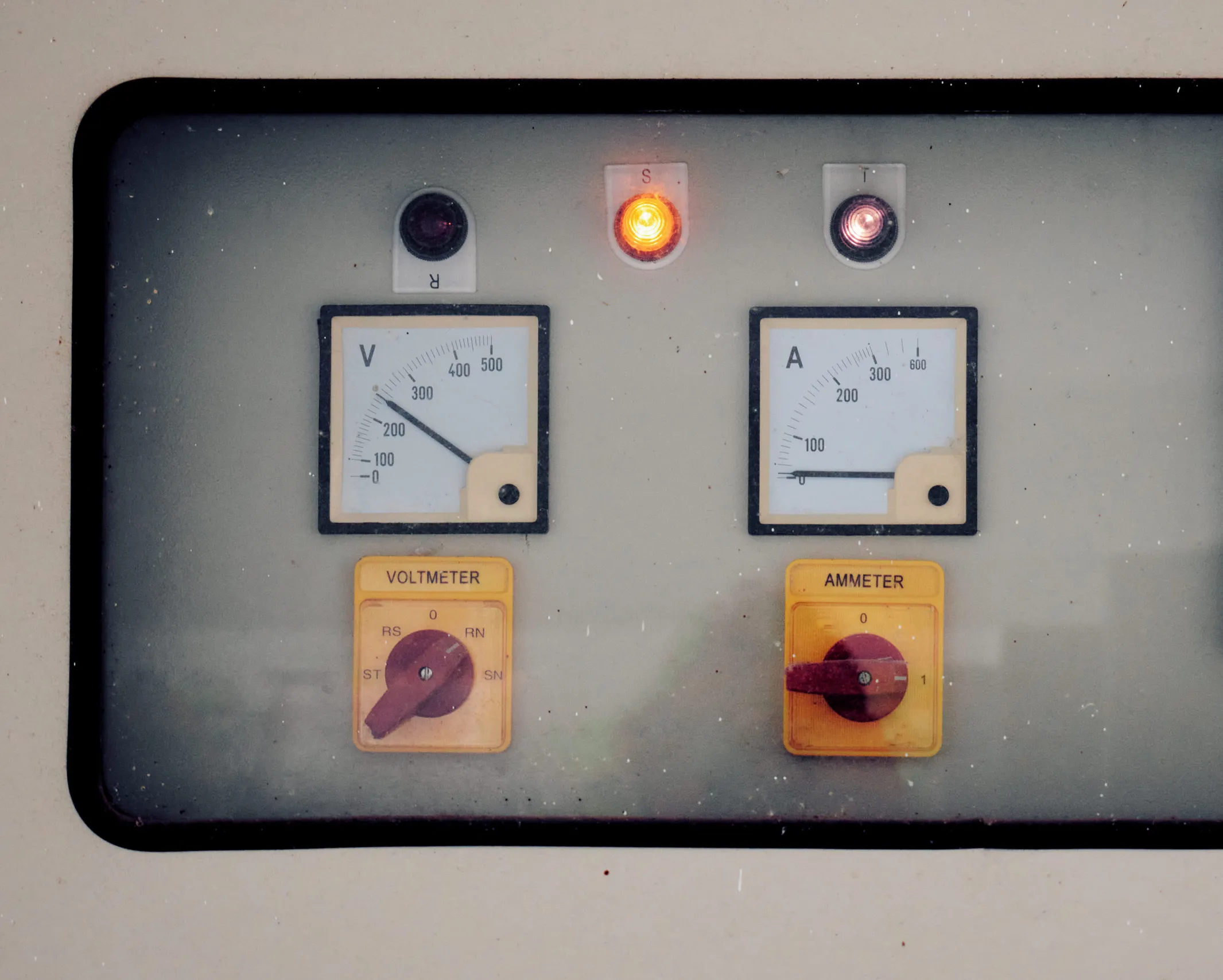
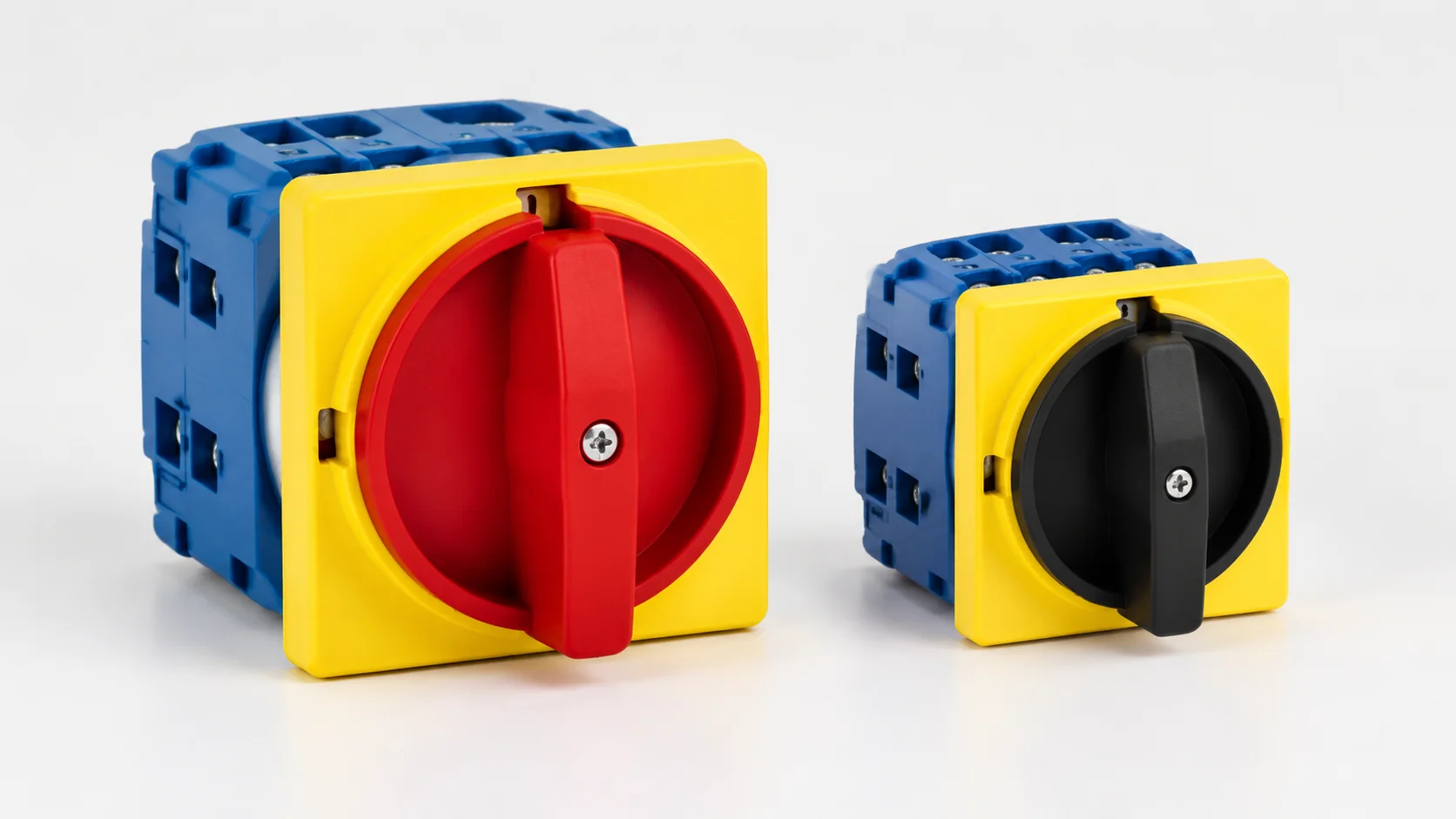
The two yellow switches on this panel select which phase the voltmeter and the ammeter read. Codes C and D hold their position, which is exactly what a measurement selector needs.
Our Production Process
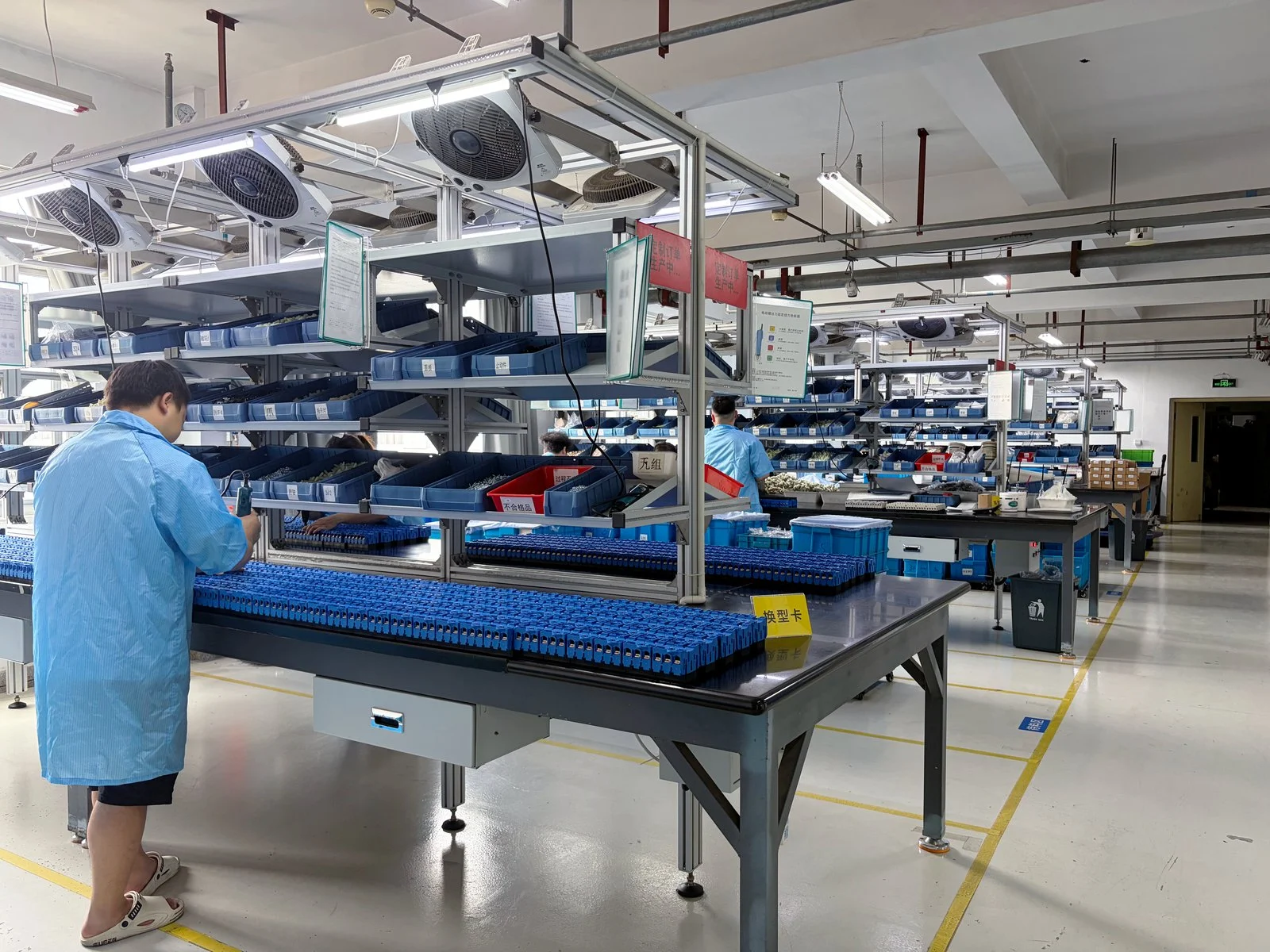
Wenzhou Changjiang Electrical Appliance Factory is located in Liushi, Wenzhou. Every LW40 cam switch goes through moulding, parts inspection, assembly, testing, packaging and loading before it leaves the workshop. The same line also builds the LW26 and LW30 series, so the process behind this switch is not a brochure page — it is the shop floor.
LW40 Rotary Cam Switch FAQ
Tap a question to open the answer.
What does the number of layers mean?
Each layer is one independent contact block with its own switching angle. One to four layers can be stacked on the same shaft, and the layer count changes the body length, which is why the catalogue writes it as L = 37 + 9.5n or L = 38 + 11.5n.
What is the difference between auto-reset and location codes?
Auto-reset codes A and B spring the handle back to the centre when released. Location codes C to R stay in the position they are set to. Mixed codes Q, S, W and Z combine both behaviours in one switch.
Can I order more than 270 degrees of rotation?
No. Code R on the fourth layer is the maximum, at 270° 0° 90° 180°. Codes M and L reach 150° to 180° on the first layer.
What is the mechanical life of the LW40?
The catalogue lists 0.3 × 10⁴ cycles without load and 0.05 × 10⁴ cycles with load, at an operation frequency of 120 times per hour. No electrical endurance figure is stated for this series.
Does the LW40 come with a key?
The key installation type is a mounting option with a key-lock cylinder fitted to the switch, so the machine cannot be switched under power. Tell us in your inquiry whether you need the cylinder, the key or both.
Can I use the LW40 on DC circuits?
Yes. The introduction states the LW40 applies up to 690 V AC and up to 440 V DC. The rated working voltage in the technical table is given as 440 V.
What is the difference between LW40 and LW30?
The LW40 is a compact machine-tool selector: 20 A to 32 A, one to four contact layers, and switching defined by an angle code. The LW30 is a main-circuit isolator from 20 A to 175 A with a single switching action per pole. Pick the LW40 when the panel needs multi-position selection, the LW30 when it needs a visible point of isolation.
Need a panel cut-out drawing for the LW40? Write to sales@cantak.cn
Request A Rotary Cam Switch Quote
Tell us the current rating, the number of layers, the angle code if you already have one, and the mounting type. We reply within 24 hours with the price, the lead time and the confirmed drawing.