







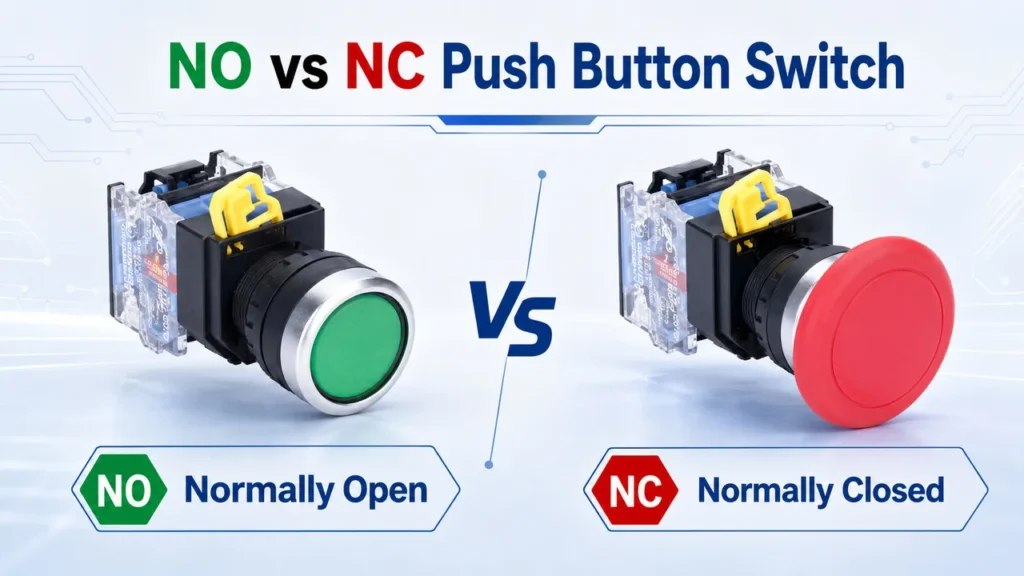
Choosing between normally open and normally closed contacts can be confusing, especially when both switches look almost identical from the outside. Yet their circuit behavior is completely different. Selecting the wrong configuration may cause a machine to respond incorrectly or prevent a safety function from working as intended.
This guide explains the key differences between an NO vs NC Push Button Switch, including how each contact operates, where it is used, and how it affects control and safety logic. It also covers internal construction, reliability, wiring behavior, and the factors to consider before selecting a switch.
Whether you are designing a control panel, connecting a PLC input, or choosing an emergency stop device, understanding these contact types will help you make a safer and more reliable decision. You can also explore other common push button switch types before comparing the two configurations in detail.
What Is a Normally Open Push Button Switch
A normally open (NO) push button keeps the electrical path disconnected when it is not in use. Pressing the button brings the internal contacts together and completes the circuit, allowing electricity to flow.
Most NO push buttons provide momentary operation. The circuit remains active only while the operator holds the button down. Releasing it separates the contacts again and stops the current.
These switches are widely used as machine start controls, testing buttons, and manual triggers. They are suitable for any application that requires a circuit to turn on briefly rather than remain active.
In industrial control systems, an NO push button can send an input signal to a PLC or energize a relay. Its simple operation makes it a practical choice for circuits that need temporary manual control.
What Is a Normally Closed Push Button Switch?
A normally closed (NC) push button keeps the electrical circuit complete when the button is at rest. Pressing it separates the internal contacts, breaks the connection, and stops the current.
This operating method makes NC switches suitable for safety controls and emergency shutdown systems. For example, an emergency stop button can use NC contacts to disconnect power as soon as the operator pushes it.
Normally closed contact arrangements are also used in float switches, limit switches, and microswitches. In industrial equipment, they often support fail-safe monitoring and control functions.
When fitted to a push-button control panel, an NC switch allows the circuit to operate continuously until it receives a stop command. It is particularly important in systems that must shut down immediately when the electrical path is interrupted.
NO vs NC Push Button Switch Working Principles
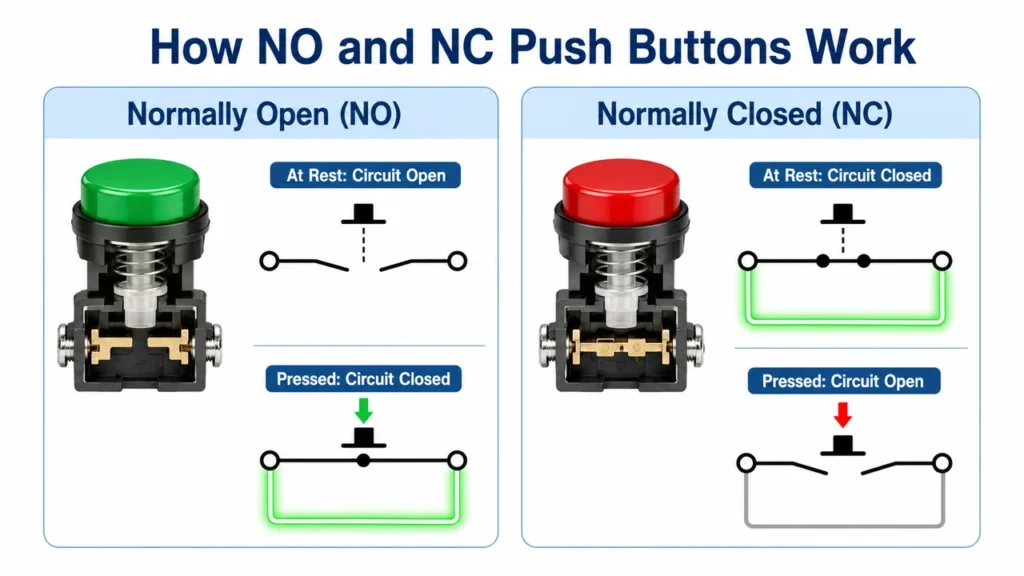
The key difference between normally open (NO) and normally closed (NC) push buttons is the position of their contacts when the buttons are not being operated.
An NO push button keeps the circuit disconnected at rest. Pressing it closes the contacts and lets current flow, creating a temporary electrical connection.
An NC push button does the reverse. Its contacts remain closed under normal conditions, allowing continuous current flow. Pushing the button opens the circuit, which can cut control power or stop a machine.
Both designs contain a contact block connected to a mechanical actuator. When the operator presses the button, the actuator moves the contacts. Depending on the switch design, this movement either completes or interrupts the circuit.
In industrial control circuits, NO and NC push buttons often operate relays, safety devices, and start-stop controls. Their consistent switching behavior makes them essential for reliable machine operation.
Applications of NO and NC Push Button Switches
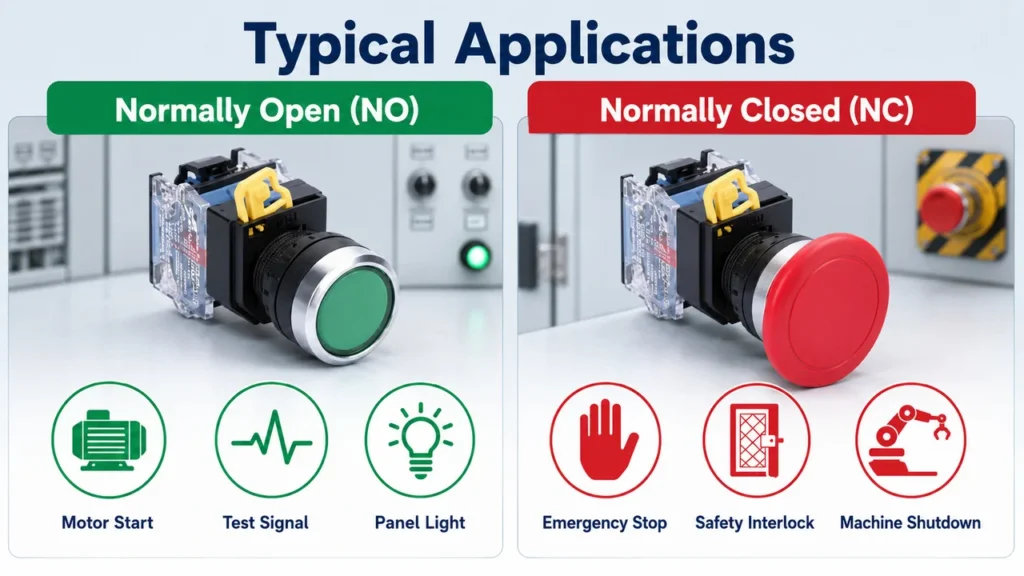
Normally open (NO) and normally closed (NC) push buttons serve different purposes in industrial control systems. The correct option depends on whether an action should complete or interrupt the circuit.
NO push buttons are commonly used for:
- Starting motors and machines
- Sending short test signals
- Turning on panel lights
NC push buttons are often chosen for:
- Emergency stop controls
- Safety interlocks on doors
- Shutdown functions in high-risk equipment
Some control systems require both contact types. A combined NO/NC push button contains one normally open contact and one normally closed contact. This arrangement offers greater wiring flexibility from a single device.
The same contact principles also appear in float switches, limit switches, and lighting controls. Float and limit switches may use NC contacts for continuous monitoring, while NO buttons can provide temporary lighting control.
Choosing the correct contact configuration helps machinery respond properly during routine operation, manual commands, and emergency shutdowns.
Security and Functional Differences
Fail-Safe Protection with NC Switches
Normally closed (NC) push buttons are widely used in fail-safe circuits. Under normal conditions, their contacts maintain a complete electrical path. If a wire breaks, an actuator fails, or the power supply is interrupted, the circuit opens and the system stops.
This built-in response makes NC push buttons suitable for emergency stops and safety interlocks.
How NO Switches Affect Control Logic
Normally open (NO) push buttons are often connected to PLC inputs to initiate brief control actions. Pressing the button sends a signal that can start a motor or activate a relay.
Because an NO contact does not interrupt a closed circuit in its default state, it is generally unsuitable for stop commands. It works well for “start,” “run,” and similar instructions in automated equipment.
Compliance with Safety Standards
Both NO and NC switches should meet standards such as IEC 60947-5-1 and IEC 60204-1. These standards cover matters such as safety ratings, wiring practices, identification, and control colors.
For instance, emergency stop devices using NC contacts commonly feature a red actuator against a yellow background. This makes the control easy to recognize.
Relevant standards also specify how a circuit should respond when power is lost. Clear identification of NO and NC terminals is required to prevent wiring errors.
Reliability in Different Applications
Electrical performance and mechanical durability both affect switch reliability. NC contacts are often selected for safety-critical systems because a broken connection causes the equipment to enter a safe state.
NO push buttons are also dependable, but they must be operated to complete the circuit. For this reason, they are better suited to activation commands than applications requiring continuous safety monitoring.
Mechanical and Structural Differences
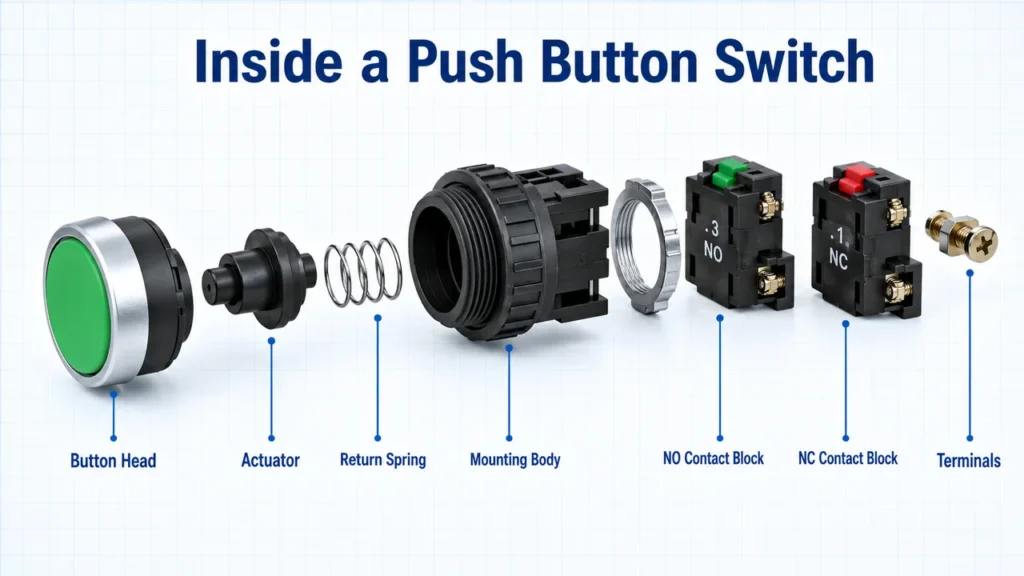
Internal Design
NO and NC push buttons often use similar external housings. Their main structural difference lies in the arrangement of the contact block and return spring.
Pressing the actuator moves the internal contacts. The contact design determines whether this movement completes an open circuit or interrupts a closed one.
Contact Materials and Service Life
Contact material has a direct effect on switch performance and lifespan. Silver alloys are widely used in standard applications, while gold-plated contacts are better suited to low-voltage signals. Circuits carrying heavier loads require materials that can withstand electrical arcing.
Durable contacts are particularly important in enclosed switches and normally closed microswitches that operate frequently or for extended periods.
Housing and IP Protection
Industrial push buttons commonly carry IP65 or IP67 ratings. These classifications indicate how well the housing prevents dust and water from reaching the internal parts.
A higher level of protection is valuable in damp, dusty, or outdoor locations. Effective housing and seals also reduce the risk of corrosion and physical damage on factory floors and control panels.
Mechanical Wear
Manufacturers measure switch life by the number of operating cycles it can complete. Many industrial models are designed to withstand more than one million actuations.
Frequent operation and continuous electrical loads can gradually wear the contacts and mechanical parts. Suitable materials and a well-designed actuator help reduce this wear, extending service life and maintaining reliable operation.
Factors for Selecting Normally Open and Normally Closed Switches

Operating Environment
In wet, dusty, or corrosive locations, choose a switch with suitable enclosure protection. IP65 and IP67 models help prevent water and dust from reaching the internal components. A properly sealed design supports dependable operation under harsh conditions.
Electrical Load
The switch rating must match the circuit’s voltage, current, and load type. Gold-plated contacts may be preferable for low-voltage signals because they maintain a reliable connection at low current levels.
Higher-power circuits require contacts rated to handle the expected electrical load. Using an underrated switch can cause overheating, arcing, or early contact failure.
Intended Function
Choose an NO push button when the operator needs to initiate an action, such as starting a machine or sending a control signal. Select an NC version for stop commands, safety interlocks, and fail-safe functions.
Some equipment uses a combined NO/NC push button. This design provides both contact arrangements in one unit and allows greater flexibility when wiring control circuits.
Maintenance and Fault Detection
An NC circuit can make certain faults easier to identify. A broken wire or damaged contact opens the electrical path and usually stops the equipment. In an NO circuit, a disconnected wire may remain unnoticed until someone tries to activate the switch.
Clear terminal labels, routine inspections, and continuity tests can simplify troubleshooting and reduce equipment downtime.
Price and Availability
Standard NO and NC push buttons are widely available and usually cost less than specialized models. Sealed switches and combined NO/NC units tend to be more expensive, but they provide additional protection or control options.
To compare contact configurations, actuator styles, dimensions, and other specifications, explore the available LA38, XB2, and AD169 models in our push button switch catalog.
Conclusion
Knowing how normally open and normally closed switches differ is fundamental to designing industrial control and automation systems. An NO switch completes the circuit when pressed. An NC switch interrupts the electrical path when operated. The correct choice depends on the required control action, operating logic, and safety function.
A clear understanding of both contact types helps avoid wiring mistakes. It also supports safer equipment operation, better circuit design, and compliance with relevant standards.
Before selecting a push button, check the electrical load, working environment, and expected circuit response. For industrial applications requiring dependable and compliant components, CanTak Switch provides a broad selection of durable push button switches.
FAQs
What happens if I install an NC switch instead of an NO switch?
The circuit will operate in the opposite way. It may remain active when the button is at rest and turn off when the button is pressed.
Can one push button include both NO and NC contacts?
Yes. Many industrial push buttons contain separate NO and NC contact blocks within one device. This combination allows the button to complete one circuit while interrupting another.
How do I identify whether a switch is NO or NC?
Set a multimeter to continuity mode and test the switch while it is not being pressed. An NO switch shows no continuity at rest and continuity when operated. An NC switch gives the reverse result.
Which contact type is better for emergency systems?
NC contacts are generally preferred for emergency stop circuits. Pressing the button opens the circuit and stops the equipment. A broken or disconnected wire also interrupts the circuit, providing fail-safe protection.