







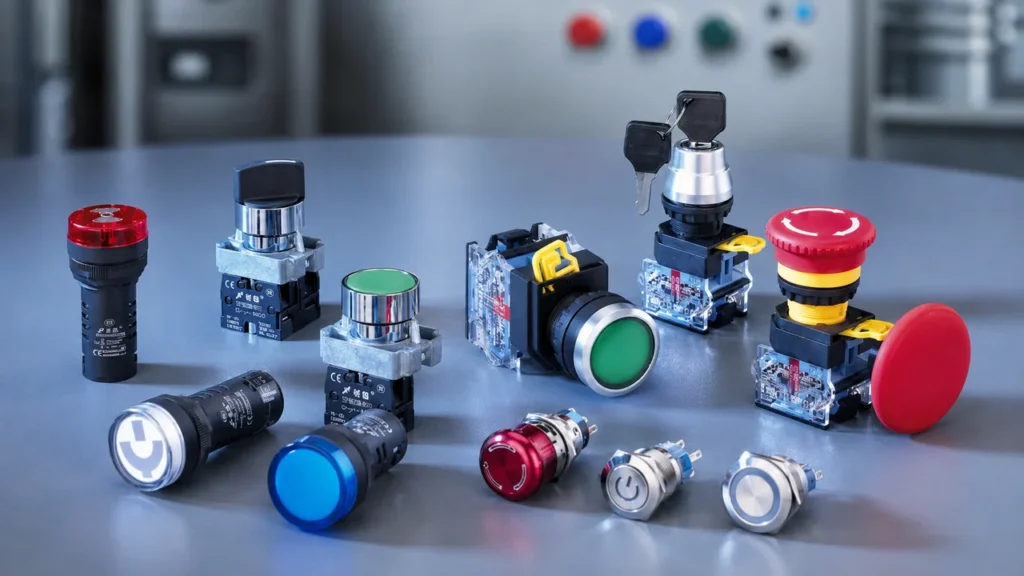
A push button on off switch is a compact device with an important purpose. With a single press, it can activate or interrupt an electrical circuit to start or stop equipment.
These switches are widely used in household appliances, machinery, automation equipment, and industrial control systems.
This article explains what a push button on/off switch is, how it operates, and where it is commonly used.
What Is a Push Button On Off Switch?
A push button on off switch is a mechanical device used to manage electrical current. Pressing its button opens or closes the circuit, allowing connected equipment to turn on or off.
Common applications include:
- 12V DC circuits in cars and boats
- AC electrical systems in homes and factories
- Industrial machinery and control panels
Several switch designs are available:
- Momentary push button switch: Works only while the button is held down
- Latching push button switch: Remains ON or OFF after the button is released
- Double-throw switch: Changes the connection between two separate circuits
Product names may vary by application. Common terms include 12V push button switch, push button power switch, and push button switch 12V on off.

Push Button On Off Switch Working Principle
The working principle of a push button on/off switch involves two actions: mechanical movement and electrical contact. Although the device has a simple appearance, its internal parts work together to open or close a circuit with each press.
Here is how the process works.
Components of a Push Button On Off Switch
A typical industrial push button switch contains several main parts:
- Actuator or button cap: The external part pressed by the user. It is usually shaped for comfortable operation and built to withstand frequent use.
- Spring mechanism: Creates tactile feedback and helps the button return to its initial position. In a momentary switch, this happens as soon as the user releases the button.
- Contact system: Determines the circuit’s default condition.
- Normally Open (NO): The circuit remains disconnected until the button is pressed.
- Normally Closed (NC): The circuit stays connected until pressing the button opens it.
- Fixed and moving contacts: Conductive metal parts that make or break the electrical connection. Silver alloy is often used to maintain reliable conductivity.
- Terminals: Connection points for external wires. They are required in both 12V push button switch installations and AC applications.
- Housing and mounting base: Support the internal mechanism while providing insulation and protection. Some housings have an IP rating for resistance to water and dust.

Push Button On Off Switch Wiring Diagram
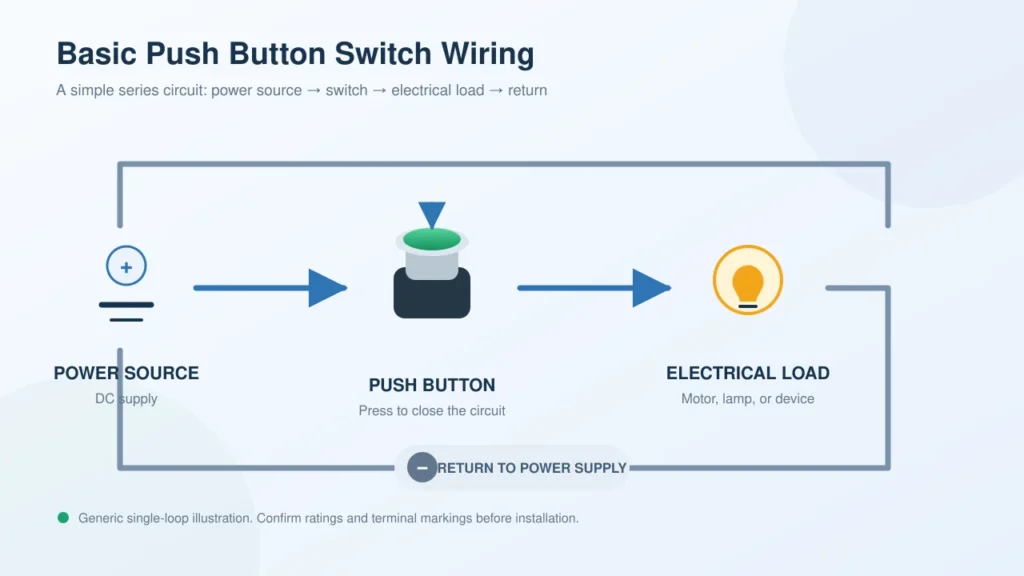
The following diagram shows a common wiring arrangement for a momentary or latching push button switch:
The wiring method varies according to the switch configuration.
- An SPST switch opens or closes one electrical circuit.
- A double-throw switch directs the connection between two circuits or functions. This design is often used to select operating modes in automation systems.
In a 12V vehicle or other low-voltage installation, the push button switch is generally wired between the battery and the connected load, such as a fan or LED light. An inline fuse is normally added for protection.
How Does It Work?
The operating sequence depends on whether the switch uses a latching or momentary design.
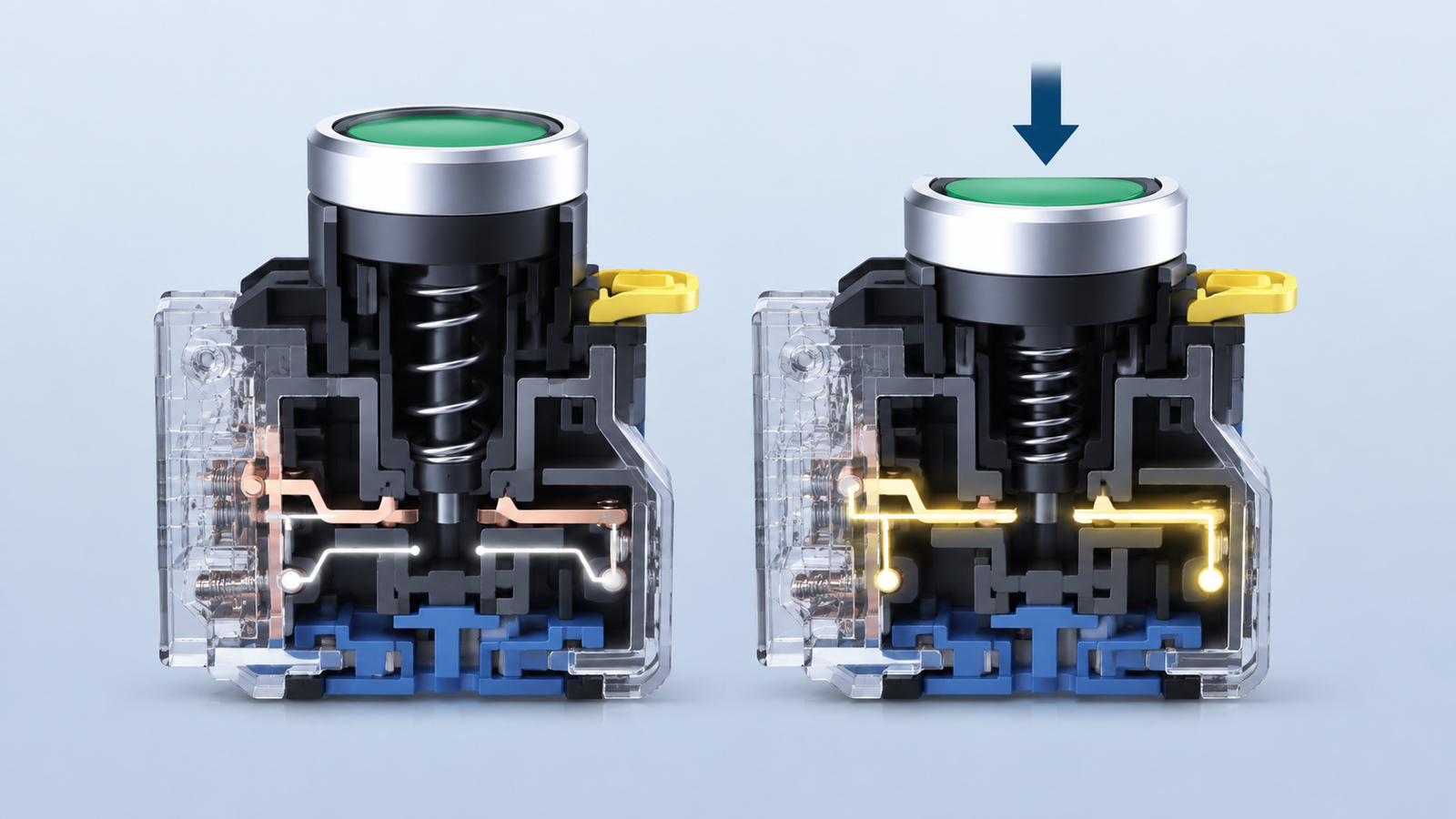
First Press: Power ON
- The user pushes the actuator.
- The internal spring compresses as the shaft moves down.
- The moving contact reaches the fixed contact.
- The circuit closes, allowing current to reach the load.
- In a latching model, an internal lock keeps the contacts in the ON position after the button is released.
Second Press: Power OFF
- Pressing the button again disengages the latch.
- The spring returns to its normal position and separates the contacts.
- The open circuit stops current from flowing, switching off the load.
- The button moves back to its starting position.
Operation of a Momentary Switch
A momentary push button works differently. It remains active only while pressure is applied.
These switches are frequently used for reset controls, testing functions, and starter signals. Once the button is released, the spring immediately returns the contacts to their default state. The switch does not retain an ON or OFF position.
Additional Features in Advanced Switches
Higher-grade industrial push button switches may also include:
- Built-in LED indicators that display operating status
- Vibration-resistant terminals that help maintain stable connections
- RC filters that reduce contact bounce in sensitive circuits
- IP65- or IP67-rated housings for dusty or wet locations
The design may vary, from a push button power switch in an industrial panel to a small momentary switch in a personal project. However, the basic principle is the same: controlled contact movement safely connects or interrupts the circuit.
Push Button Switch Applications and Use Cases
Because of their simple operation and flexible design, push button on/off switches are found in many types of electrical equipment. Common applications include:
- Household electronics: Used in lamps, coffee machines, and desktop computers
- Vehicles: Installed as 12V push button switches for engine start and stop controls
- Industrial automation: Used to start motors or operate conveyor systems
- Safety and security equipment: Momentary push button switches are commonly fitted to emergency stop controls
- DIY electronics: Suitable for small projects and low-voltage 12V DC circuits
Push button switches also serve as manual input devices in automated systems. They allow operators to control equipment quickly, safely, and reliably.

Conclusion
A push button on/off switch is small, yet it provides dependable control in many electrical systems. Momentary models respond only while pressed, while latching and double-throw designs support different switching requirements.
Understanding these operating differences makes selecting a suitable push button power switch easier. Whether it is intended for a DIY circuit or industrial machinery, the correct model should match the project’s voltage, control function, and working conditions.