







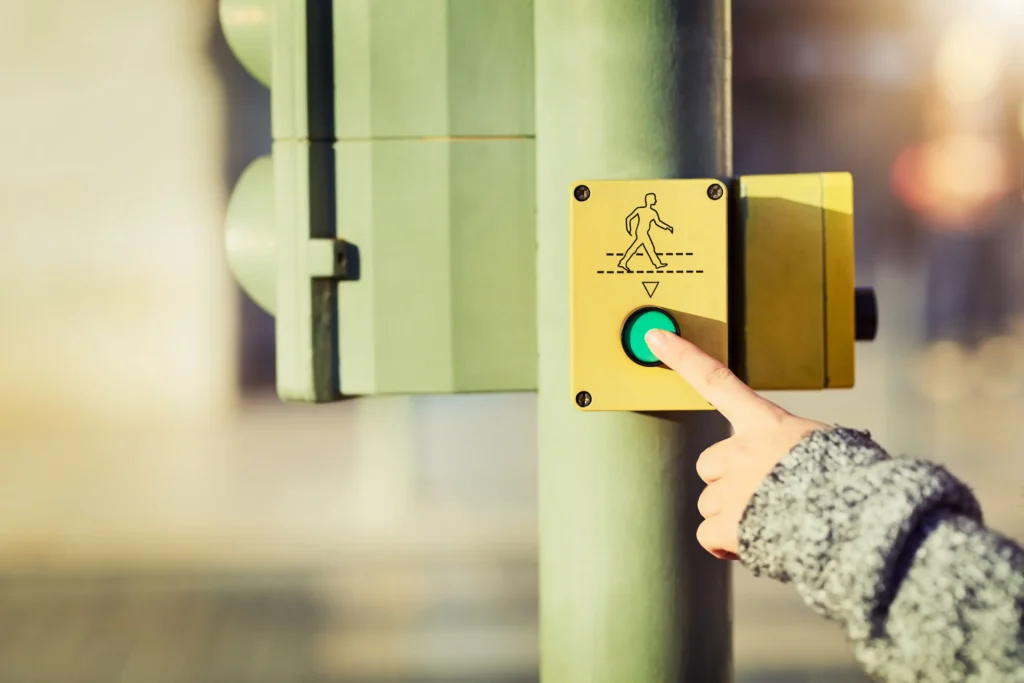
A momentary switch is a switch whose contact returns to its rest state as soon as the actuator is released. It describes a behaviour, not a shape: the same behaviour belongs to a doorbell button, a keyboard key, a spring-loaded toggle, a foot pedal, a limit switch lever and the start button on a machine panel. What they share is that nothing stays switched after the operator lets go.
The opposite behaviour is a maintained or latching switch, which stays where it is put until it is operated again. Confusing the two is the most common error in switch selection, and it is an error that only shows up in service — a machine that keeps running, a circuit that stays live, a reset that never resets.
What Momentary Means, Precisely
The term is defined in the switch standards rather than left to habit. Under IEC 60947-5-1 a momentary action contact returns to its rest state when the actuator is released; a maintained action contact stays in the operated state until a second operation. Two consequences follow, and both matter when you are reading a datasheet.
The rest state is electrical, not mechanical. A momentary switch is not “normally open” or “normally closed” by nature. The contact block behind the actuator decides: an NO block is open at rest and closes while actuated, an NC block is closed at rest and opens while actuated. The same momentary switch body can be supplied either way.
Momentary is not the same as “safety”. A momentary switch is safer in the specific case where the machine must stop when the operator lets go, and less safe where a deliberate state has to be held. Which one is correct comes from the risk assessment or the circuit design, not from a preference.
The Momentary Switch Family, by Form
Because “momentary” describes behaviour, the same word covers devices that look nothing alike. The table groups the forms that come up most often in industrial and commercial work.
| Form | How it returns | Uso típico |
|---|---|---|
| Botão | Internal spring | Start, reset, jog, doorbell |
| Toggle, spring-loaded | Spring returns the lever to centre | Test positions, temporary override |
| Rocker / paddle | Spring, often one side only | Handheld controls, automotive, appliances |
| Micro switch | Leaf spring with an over-centre action | Interlocks, position sensing, door detection |
| Limit switch | Lever or plunger on a spring | End of travel, gate and guard position |
| Foot switch | Pedal on a return spring | Hands-free operation, welding, sewing, presses |
| Membrane / keypad | Domed membrane | Control panels, instruments, appliances |
| Reed switch | Magnetic, returns when the field is removed | Door and window sensing, low-power signalling |
The return mechanism is the part that fails. A spring that fatigues, a membrane dome that cracks, a leaf spring that takes a set — in every case the switch stops returning fully, and the symptom depends on whether the contact is NO or NC. On an NO contact a weak return leaves the circuit open when it should be closed; on an NC contact it leaves the circuit open permanently, which is at least fail-safe but reads as a dead machine.
Momentary Contact Switch: The Same Device Under Another Name
“Momentary contact switch” is the term used when the emphasis is on the contact rather than the actuator, and it appears constantly in American technical writing and in catalogue cross-references. It describes exactly the same behaviour: the contact makes or breaks only while the actuator is held.
The reason the phrase matters is search and cross-reference rather than engineering. A part listed as a “momentary contact switch” may be a micro switch, a push button, or a limit switch, and the datasheet is the only reliable way to tell. What transfers between all of them is the contact rating and the contact arrangement, not the housing.
NO or NC: What Happens When You Let Go
The clearest way to understand a momentary switch is to look at both contact types at rest and while pressed.

An NO momentary switch is open at rest, closes while held, and opens again on release. An NC momentary switch is closed at rest, opens while held, and closes again on release. Both are momentary; neither is “safer” in the abstract.
The practical difference is what a broken wire does. An NC momentary contact wired as a stop function fails safe: a broken wire looks like a pressed button, and the machine stops. An NO contact wired as a start fails safe in the other direction: a broken wire means the machine cannot start. That asymmetry is why stop circuits use NC contacts, and it is a wiring convention rather than a property of the switch.
In catalogues, a momentary position is written in brackets: (on)-off-(on) is a centre-off toggle whose two outer positions are momentary, while on-off-on is the same switch in maintained form. Reading those brackets correctly is often the only difference between two part numbers.
How to Test a Momentary Switch
Whether you are identifying an unknown switch or proving a replacement, the same four steps settle it.
- Isolate the circuit. A continuity test on a live circuit gives a meaningless reading and a possible shock.
- Disconnect at least one side. A switch tested in circuit reads through the rest of the loop and tells you nothing.
- Ajuste o medidor para a função de continuidade ou resistência. With the actuator at rest, note which pairs read closed and which read open.
- Operate and hold, then release. If the reading changes while held and returns to the original state on release, the switch is momentary. If it stays changed, it is maintained.
On a multi-contact switch, test every pair at both states. Two contacts that look alike on the outside can be arranged in opposite senses, and a switch with four terminals is not necessarily two isolated circuits — the pairs may share a common.
Where Momentary Switches Are Used
The behaviour suits commands and sensing, and it is the wrong choice for states.
Commands that should not persist. A doorbell, a start button, a reset, an acknowledge, a jog. Each is a pulse, and a pulse is exactly what a momentary switch produces.
Sensing a position. A limit switch or micro switch is momentary by construction: the lever is deflected while the gate or guard is in a particular place and returns when it moves. Here the “release” is the machine moving away, not a hand.
Hold-to-run control. A foot switch or pendant button that must be held for the machine to move. The momentary behaviour is the safety function, not an inconvenience.
Human interface devices. Keyboard keys, mouse buttons and most consumer controls are momentary, with the latching done in software. That is the same pattern as an industrial start button wired through a holding contact: the switch gives an edge, the logic holds the state.
Ratings: A Doorbell and a Contactor Coil Are Not the Same Load
Two momentary switches that look identical can differ by two orders of magnitude in what they can switch. The numbers that matter are the utilisation category and the contact material.
| Duty | Categoria | What the contact sees |
|---|---|---|
| Signalling into a PLC or logic input | Often unrated, milliamps | Almost nothing — but contact film becomes the failure mode |
| Resistive AC load | AC-12 | Full current, no inductive kick |
| Contactor coil, relay, solenoid | AC-15 / DC-13 | Inductive energy that has to be absorbed at every break |
| Motor starting | AC-3 and above | Several times running current at the instant of starting |
The AC-15 and DC-13 categories are where most small switches are actually used, and they are also where the ratings fall fastest with voltage. A contact rated 6 A at 230 V AC is typically good for around 1 A at 110 V DC, because direct current has no zero crossing to help extinguish the arc.
Contact material matters in the opposite direction. Silver contacts need a certain amount of arcing to stay clean; on a circuit that only ever carries a few milliamps they can develop a sulphide film and start reading as open. Gold-plated or gold-alloy contacts are specified for exactly that case — dry-circuit and low-level signal switching — and are wasted money on a contactor coil.
Momentary or Latching: How to Decide
| Question | Momentâneo | Latching / maintained |
|---|---|---|
| Must the state end when the operator walks away? | Sim | Não |
| Is the switch giving a command or holding a state? | Command | State |
| Does a controller latch it afterwards? | Usually yes | Not needed |
| Is there a defined off position? | Not applicable | Required |
| Typical devices | Start, reset, jog, limit, foot pedal | Mode selector, isolator, power switch |
The decision is usually made by asking one question: if the operator collapsed, or walked away, or the switch was knocked, what should the machine do? If the answer is “stop”, the control needs momentary action with the hold provided by a contactor or a PLC. If the answer is “stay as it was”, the switch is latching.
Where a Momentary Switch Is the Wrong Choice
Because momentary is the default for commands, it gets specified for states by mistake. Four situations account for nearly all of those mistakes.
Isolation and lock-off. A device used to isolate a circuit for maintenance has to stay open while the work is done, and it has to be padlockable. A momentary switch cannot do either. The requirement here is a switch-disconnector with a visible break, not a momentary control device.
Mode selection. Hand / Off / Auto is a state that has to persist while the machine runs. A momentary selector would drop back to Off the moment the operator let go, which is why mode selectors are maintained — and why a spring-return three-position selector is only used for test positions. The guide to the three position selector switch sets out which positions are normally maintained and which are not.
Anything a controller has to remember across a power cycle. A momentary press into a PLC gives a rising edge. If the controller restarts, the edge is gone, and the machine comes back in a different state than it went down in. Where the state has to survive, it needs to be held in a latching device or in non-volatile logic, not inferred from a button that was pressed once.
Load switching that has to stay on. A momentary switch cannot keep a contactor energised, and using one through a relay only moves the problem: the relay now carries the holding duty and has to be rated for it.
The pattern is consistent. Momentary is for commands — a press, a pulse, a hold-to-run. Maintained is for states — a mode, an isolation point, a power setting. Nearly every wrong choice is one of those two applied to the other case.
Five Mistakes With Momentary Switches
- Using a maintained switch for a jog function. The machine keeps moving after the operator releases, which is exactly the hazard jog control exists to prevent.
- Wiring a momentary start without a holding contact. The machine runs only while the button is held. It looks like a fault and is actually a missing auxiliary contact.
- Assuming a red mushroom head is an emergency stop. A spring-return momentary operator is not an emergency stop; the device has to latch and have positive opening.
- Under-rating the contact for a coil. A switch rated for a resistive load welds its contacts on an inductive load, after which a momentary switch behaves like a permanent one.
- Choosing gold contacts for a power circuit. Gold is for dry circuits. On a contactor coil it erodes quickly and the switch fails early for the opposite reason.
PERGUNTAS FREQUENTES
What is a momentary switch?
A switch that returns to its rest state when the actuator is released. It changes state only while it is held, and it is defined that way in IEC 60947-5-1 rather than by its shape.
What is the difference between a momentary switch and a latching switch?
A momentary switch reverts as soon as you let go; a latching switch stays in the position it was put in until it is operated again. In circuit terms, momentary gives a pulse and latching gives a state.
Is a momentary contact switch the same thing?
Yes. “Momentary contact switch” emphasises the contact rather than the actuator, and it describes the same behaviour. The phrase is common in American catalogues and cross-references.
How can I tell if a switch is momentary?
Test it with a meter out of circuit: the reading changes while the actuator is held and returns to its original state when released. A maintained switch stays changed. In a catalogue, a momentary position is written in brackets, such as (on)-off-(on).
Are momentary switches normally open or normally closed?
Either, and both can be momentary. The NO or NC behaviour comes from the contact arrangement, not from the momentary action.
Can a momentary switch be used as a power switch?
Only with a relay, contactor or controller that holds the circuit. A momentary switch alone cannot keep a load energised, because it opens as soon as it is released.
Why does my momentary switch stay on after I release it?
Either the return spring has failed, or the contacts have welded from switching an inductive load they were not rated for. A welded contact turns a momentary switch into a permanent one, and it should be replaced rather than cleaned.
What is a momentary foot switch used for?
Hands-free control where the machine should only move while the pedal is held — welding, sewing, small presses, and positioning equipment. Where the machine must keep running, a maintained pedal with a latch is used instead.
Choosing by Behaviour First
Almost every momentary switch problem traces back to the same three decisions: is the action momentary or latching, is the contact NO or NC, and what load is it switching. The form — toggle, pedal, button, lever — comes after those, because the form is about how the operator reaches it, not about what the circuit does.
For the panel-mounted version of this device, including contact blocks, terminal numbering and the holding circuit, the Guia sobre interruptores momentâneos de botão goes through the details. The wider switch families are compared in the Guia de seleção de tipos de interruptores rotativos, and if you need to identify the terminals on a switch in your hand, the guia de pinagem covers the numbering.
The range of panel operators and the contact blocks that go with them is listed on the página sobre interruptores de botão e lâmpadas de sinalização, and the wider switch families sit alongside it on the rotary switch and isolator range.
Tell us what the switch has to do when it is released, what it is switching, and how the operator reaches it, and we will come back with the action, the contact arrangement and the rating rather than a part number that looks close.