


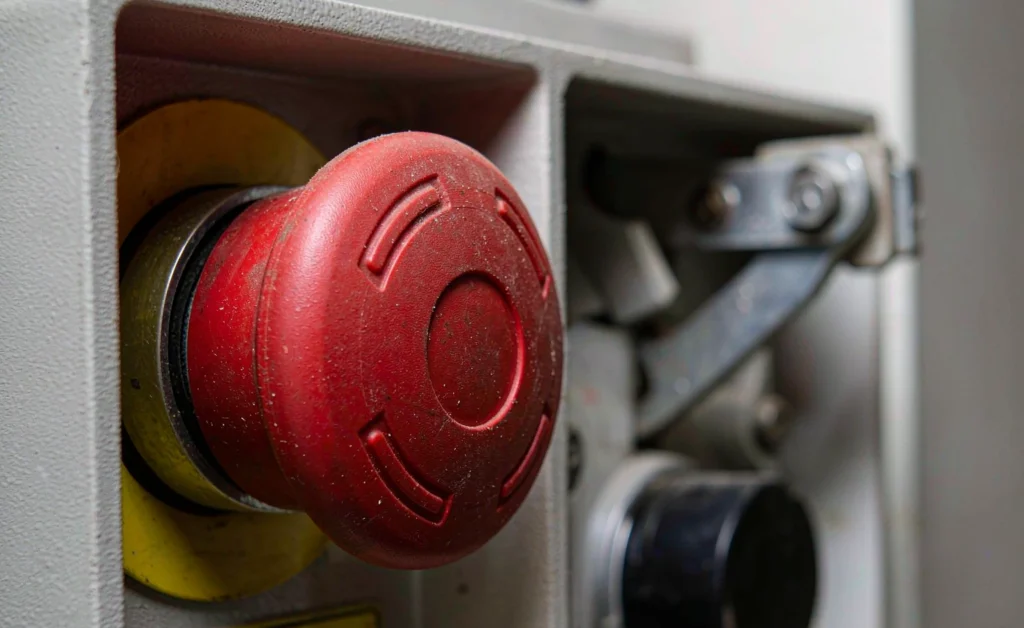
An emergency stop push button is a latching control device that stops a machine when a person hits it, and stays stopped until somebody deliberately resets it. Two properties make it different from every other button on the panel: it latches in the operated position, and its contact opens by positive mechanical action rather than by spring force alone.
Both of those are requirements, not design preferences. They are set out in IEC 60947-5-5 for the device and in ISO 13850 for the function, and a red mushroom head on a spring-return operator fails both. It looks like an emergency stop, it is labelled like one, and in an actual emergency it will not do the job.
What Makes an Emergency Stop Push Button Different
| Requisito | What it means in practice | What a normal button does instead |
|---|---|---|
| Latching action | Stays operated until deliberately released | Returns as soon as it is released |
| Positive opening | The NC contact is forced apart by the mechanism, not by a spring | Relies on spring pressure, which can weld or stick |
| Defined release | Twist, pull or key release — a deliberate act | No release action; the spring does it |
| Mushroom actuator | Large target, operable by palm or fist | Flat or high head, operated by a finger |
| Red actuator | Recognisable at a glance from across the cell | Any colour, chosen for function |
On an emergency stop push button the latching requirement is the one that gets missed. A spring-return button with a red mushroom head returns to its rest position the moment the operator lets go, which means the machine can restart while the person is still reaching into it. Latching is what keeps the stop applied.
The positive opening requirement is subtler and more important over time. An ordinary NC contact opens because a spring pulls it open. If the contacts weld — which they do, under fault current or after many operations — the spring cannot separate them, and the button feels like it worked while the circuit stays closed. Positive opening uses the actuator to drive the contact apart mechanically, so a welded contact is torn open rather than left closed.
Release Types on an Emergency Stop Push Button
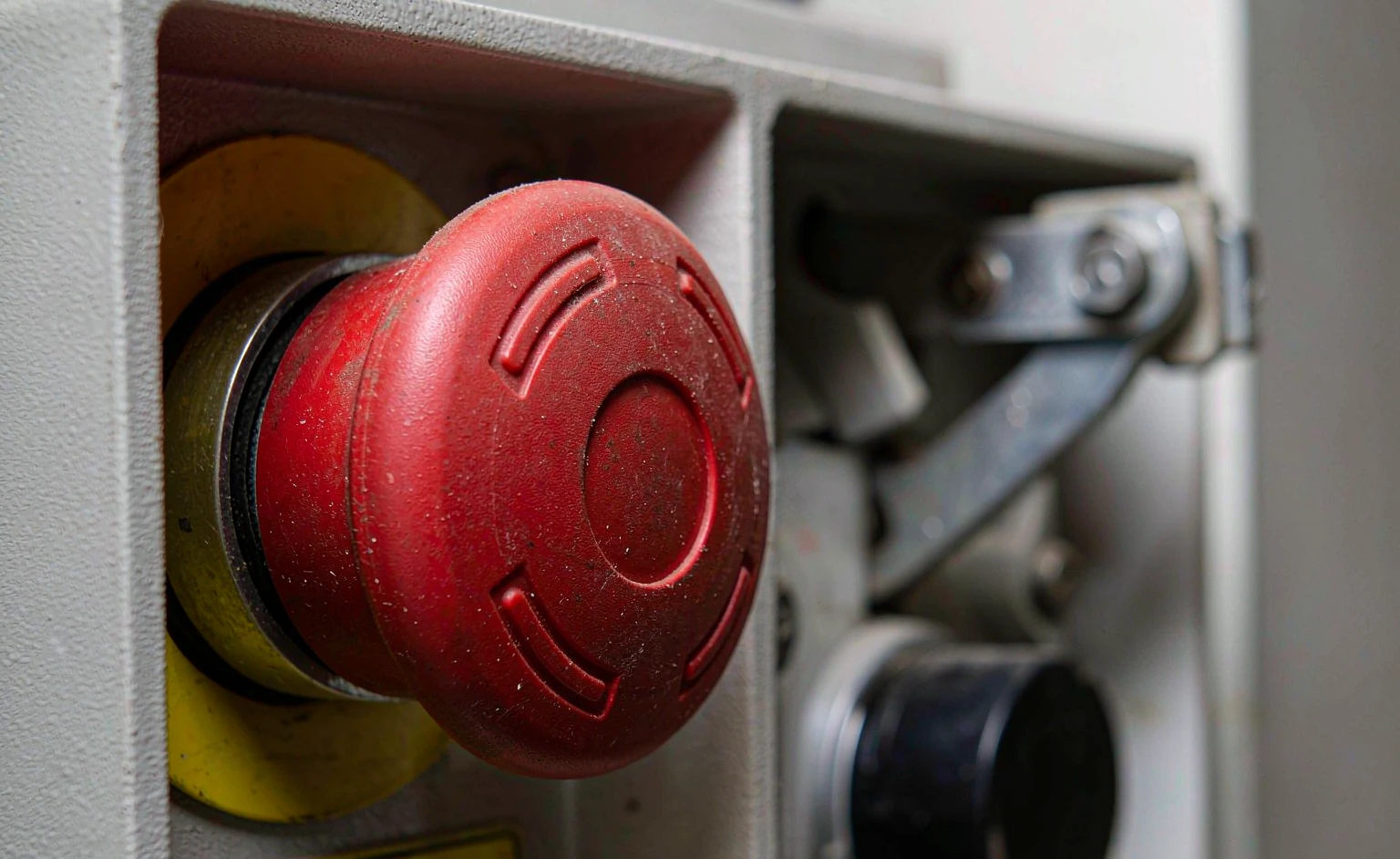
The release action is how the device is reset after it has been hit, and the choice depends on who resets it and what has to happen first.
| Release type | How it works | Onde é utilizado |
|---|---|---|
| Twist release | Rotate the head to unlatch | The default on machine panels; simple and quick |
| Pull release | Pull the head outwards | Where a twist is awkward, or where the button is recessed |
| Key release | Only a key holder can reset | Where restarting has to be a supervised decision |
| Shrouded or guarded | Additional collar around the head | Where accidental operation is likely, or where the button is exposed |
Releasing the device is not the same as restarting the machine, and this is a distinction the standards are explicit about. Releasing the emergency stop removes the stop command; it must not, by itself, cause the machine to start. Restart needs a separate and deliberate action — a start button, a reset on the controller, or a deliberate sequence. Panels that restart on release are relying on the operator’s reflexes rather than on the control system.
Positive Opening and the Contact Behind It
Not every NC contact has positive opening, and the difference is not visible from the front of the panel. A direct opening action contact is built so that the actuator pushes the moving contact away from the fixed one through a rigid path. The datasheet will say so, and the symbol on the device often includes a small mark indicating direct opening.
This matters when the emergency stop push button is wired into a contactor coil circuit. In that arrangement the NC contact carries the coil current, which is small — but the contact can still weld if the coil circuit develops a fault, or if the contact has been sitting closed with a light film on it. A welded emergency stop contact is a silent failure: the machine keeps running, the button is pressed, and nothing happens.
A dual-channel emergency stop push button, with two NC contacts that both have positive opening, is the arrangement used where the risk assessment calls for a higher performance level. The two channels are monitored by a safety relay, which detects a discrepancy between them — a welded contact in one channel, a broken wire in the other — and refuses to allow a restart.
Wiring an Emergency Stop Circuit
Three arrangements account for most installations, and they are not interchangeable.
Single channel, in series with the coil. On the emergency stop push button the NC contact is wired in series with the contactor coil, and one or more emergency stops are wired in series with each other. Simple, and adequate for low-risk machinery. The weakness is that a welded contact or a short across the contact is undetectable until the button is pressed.
Dual channel into a safety relay. Two NC contacts are wired to two inputs of a safety relay, which monitors both. This is the normal arrangement for machinery that has to reach a performance level above the most basic category. It costs a relay and an extra core, and it buys detection of the failure modes the single-channel circuit cannot see.
Emergency stop as a controller input. The contact feeds a safety input on a drive or a safety PLC rather than a contactor. Common on machines with electronic drives; the principles are the same, but the input has to be a safety-rated input rather than a standard digital input.
In all three, the contacts are wired in series along the loop rather than in parallel. Parallel emergency stops mean that operating one does not stop the machine if another is bypassed, and series is what makes every device in the chain able to stop it.
Where to Mount an Emergency Stop Push Button
An emergency stop push button that cannot be reached is not an emergency stop. The mounting points follow from how the machine is operated rather than from the panel layout.
- At every operator position — within reach of the person who is running the machine, without having to walk around it.
- At every point where a person enters the machine’s danger zone — so that someone reaching in can stop it before the movement reaches them.
- Visible from the operating position — not hidden behind a door, a guard or a stack of material.
- Not inside the guarded area unless there is also one outside. A stop button that can only be reached after entering the hazard is doing nothing.
Height and orientation matter less than reach and visibility, but a button mounted at knee height on a machine with a low guard is a common and avoidable mistake.
What an Emergency Stop Cannot Do
An emergency stop is a complementary protective measure. It is not a substitute for guarding, for interlocked doors, or for a proper risk assessment, and treating it as one is the most common conceptual error on machine panels.
The device stops the machine; it does not prevent access to the hazard, and it does not protect against a hazard that appears faster than a person can react. Guards and interlocks prevent access; the emergency stop is what remains for the cases nobody anticipated. A machine that relies on the emergency stop as its primary protection has no primary protection.
Two related mistakes follow from the same confusion. The first is using the emergency stop as a normal stop button, which wears the mechanism and trains operators to treat it casually. The second is wiring the emergency stop in series with the start circuit in a way that makes it impossible to tell, at the panel, whether the stop has been operated or a wire has simply come loose.
Common Mistakes With Emergency Stop Push Buttons
- Fitting a spring-return mushroom button. It does not latch, so it cannot hold the stop, and it fails the device standard outright.
- Using a block without positive opening. The contact may look like an NC contact and behave correctly for years, until the day it welds.
- Restarting on release. Releasing the button must not start the machine; restart has to be a separate deliberate action.
- Parallel rather than series wiring. Every device in the loop has to be able to break it on its own.
- Single channel on a machine that needs dual. The risk assessment decides this, not the panel builder’s stock list.
PERGUNTAS FREQUENTES
What is the difference between an emergency stop and a normal stop button?
An emergency stop latches in the operated position and has positive opening contacts; a normal stop button is momentary and returns when released. The emergency stop is for unanticipated hazards, the stop button is for routine stopping.
Does an emergency stop have to latch?
Yes. IEC 60947-5-5 requires the device to remain in the operated position until a deliberate release action is performed. A spring-return button does not meet that requirement.
What is positive opening?
A contact arrangement in which the actuator mechanically forces the NC contact apart, rather than relying on a spring. It guarantees the circuit opens even if the contacts have welded.
Can I use a standard 22 mm mushroom push button as an emergency stop push button?
Only if it is a latching device with positive opening contacts and is marked as an emergency stop device. A spring-return mushroom head is not one, however similar it looks.
Should the machine restart when I release the emergency stop?
No. Releasing removes the stop command; restarting requires a separate deliberate action. Automatic restart on release is a hazard, not a convenience.
How many emergency stops can be wired in series?
There is no fixed limit in the device standard, but every additional device adds resistance and another point of failure, and long series loops become hard to diagnose. Keep the loop short and use a safety relay where the arrangement grows.
Do I need a safety relay for an emergency stop?
Not always. A single-channel circuit into a contactor coil is acceptable for low-risk machinery. Where the risk assessment requires a higher performance level, a dual-channel device monitored by a safety relay is needed.
What colour should an emergency stop be?
Red actuator, conventionally on a yellow background, so that it is recognisable from a distance. Colour alone does not make it an emergency stop; the latching and positive opening are what do that.
Get the Device and the Circuit Right
Choosing an emergency stop push button and designing the circuit are separate decisions. The button has to latch and open positively; the circuit has to be arranged so that every device can stop the machine, and so that releasing it does not restart anything. A correct button in a single-channel circuit on a machine that needed dual is still a shortfall, and so is a dual-channel circuit with a momentary button at the end of it.
The latching operators and the matching contact blocks are listed on the push button switch and signal lamp page, and the terminal numbering for the blocks is in the pinout guide. If you need to distinguish NC from NO behaviour before wiring, NO vs NC push button switch sets out the contact logic, and the momentary push button switch guide explains why a momentary operator cannot serve as an emergency stop.
Tell us the machine, the risk assessment outcome and how many stop points are needed, and we will come back with the operator, the release type and the contact arrangement rather than a mushroom head that only looks the part.