


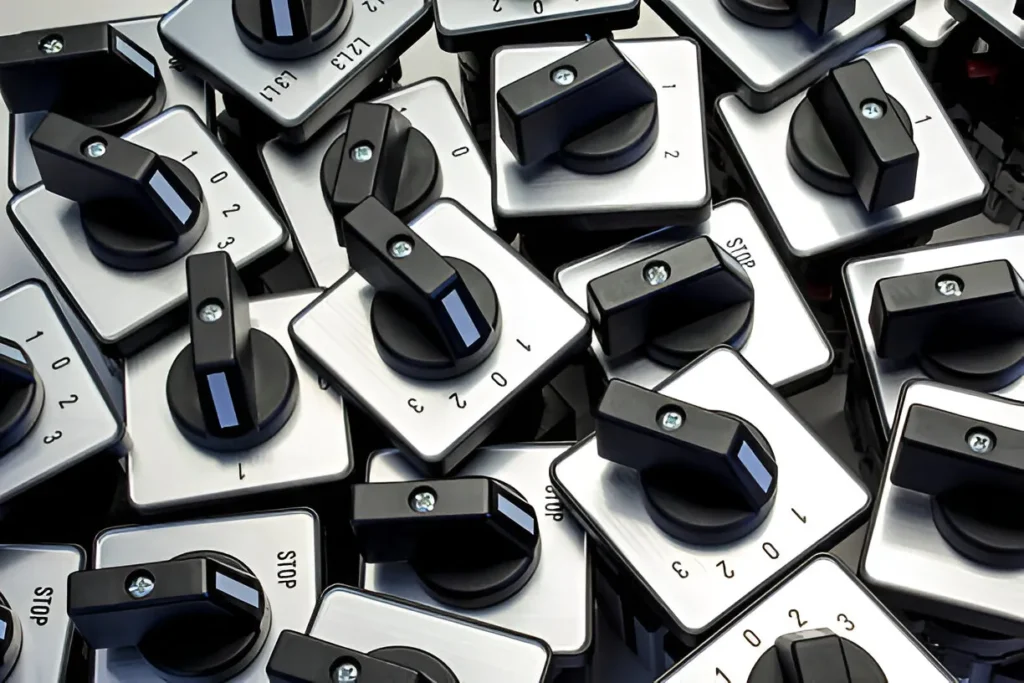
A motor reversing switch changes the direction of a three-phase motor by swapping two of the three phases. It has three positions — forward, off, reverse — and the handle has to pass through off before it can reach the other direction, which is what makes the changeover safe rather than a race between two contactors.
The idea is simple enough that it gets taken for granted, and that is where the failures come from. A motor reversing switch has to break motor current, not control current; the interlock has to survive somebody forcing the handle; and the wiring has to swap exactly two phases, because swapping three produces a motor that runs in the direction it always did.
What a Motor Reversing Switch Does in Its Three Positions
In the forward position the motor sees the phase sequence L1-L2-L3. In the reverse position it sees L1-L3-L2. The middle position opens all three poles, so there is a defined interval with no connection between the supply and the motor.
That interval is the whole point of the mechanical version. Two contactors can also reverse a motor, but they can close at almost the same instant, and if they do, two phases are shorted together through the contactors. A cam switch removes that possibility mechanically: the moving contact leaves one set of terminals before it reaches the other.
| Position | What is connected | Typical use |
|---|---|---|
| Forward (1) | L1-U, L2-V, L3-W | Normal running direction |
| Off (0) | All poles open | Stop, and the dead time between directions |
| Reverse (2) | L1-W, L2-V, L3-U | Opposite rotation |
Because the off position is mechanical, a motor reversing switch does not need a reversing timer. Systems built from two contactors usually do, since the contactors need to be prevented from overlapping for at least the arc time of the first one.
Motor Reversing Switch or Two Contactors?
Both approaches are common, and they suit different duties. The choice is mostly about how often the direction changes and who is operating it.
| Reversing cam switch | Two contactors | |
|---|---|---|
| Interlock | Mechanical, built into the mechanism | Mechanical and electrical, added by the panel builder |
| Operation | Manual, local | Remote, from a PLC or push buttons |
| Dead time | Provided by the off position | Needs a timer or an interlock relay |
| Switching frequency | Occasional, operator-paced | Frequent, automated |
| Visible position | Yes, printed on the handle plate | No, unless indicating lamps are added |
| Best for | Hoists, doors, machine set-up, maintenance jogging | Production cycling, automatic sequences |
A cam switch is a manual device, and that limits it. It is not designed for a reversing cycle every few seconds; for that, contactors with an interlock are the right answer. Where the direction changes a few times a shift, or where the operator needs to see and feel which direction is selected, the switch is simpler and has fewer failure points.
Why Two Phases and Not Three
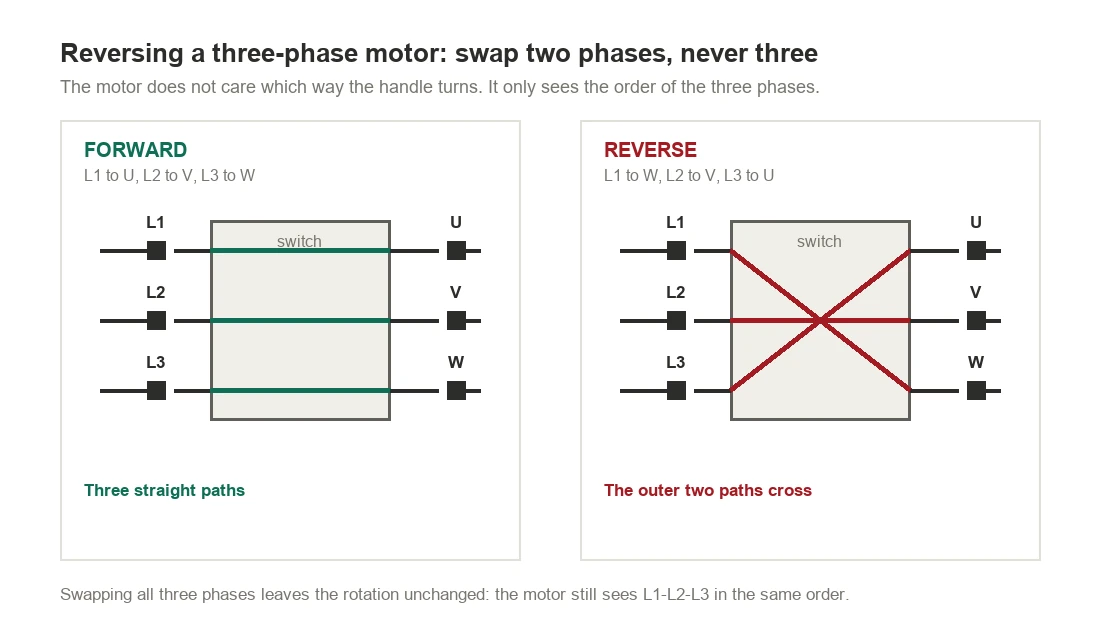
Reversing a three-phase motor means changing the order in which the phases arrive at the windings. Swapping any two produces that change. Swapping all three does not: L3-L2-L1 is the same cyclic order as L1-L2-L3, just started from a different point, so the motor keeps turning the same way.
This is not a theoretical point. Every year some installations are wired with all three phases crossed at the switch — usually because the terminals were landed in the wrong order during a replacement — and the symptom is a machine that reverses only on paper. The handle says reverse, the contactor picks up, and the motor runs forward.
Single-phase motors are a different case. There is no phase sequence to swap, so reversing is done by reversing the connections of the start winding relative to the run winding, which is a change inside the motor terminal box rather than at the switch. A three-phase reversing switch is the wrong device for that job.
The Interlock Inside a Motor Reversing Switch
A motor reversing switch contains a mechanical interlock: the mechanism prevents the forward and reverse contact sets from being closed at the same time. That is a property of the switch, and it is the reason a cam switch is safer than a pair of contactors in the same application.
But the interlock is a mechanism, and mechanisms get forced. Where the reversing switch feeds two contactors rather than the motor directly — a common arrangement on larger drives — the contactors need their own electrical interlock as well, wired so that the forward coil is fed through a normally closed auxiliary contact on the reverse contactor and vice versa. One interlock protects against the mechanism wearing; the other protects against a person with a screwdriver.
Two further points belong with the interlock. The off position should be used deliberately, not skipped by turning the handle quickly — on a large motor the residual back-EMF is still present for a moment after the supply is removed, and reversing into it produces a current spike far above starting current. And a reversing switch must never be used as the only means of isolation; it is a control device, not a lockable isolator, unless it is specifically built as a combination.
Rating a Motor Reversing Switch for Motor Duty
The number that matters on a motor reversing switch is the motor rating, not the thermal current. A switch that carries 20 A continuously can be a very different device when it has to break a stalled motor.
| Figure on the datasheet | What it means | Why it matters here |
|---|---|---|
| Ith (thermal current) | Continuous current, no switching | The largest number, and the least relevant to a reversing duty |
| AC-3 / AC-23 | Motor load, including stalled rotor | The rating that decides whether the contacts survive |
| Rated operational voltage | The voltage at which the rating applies | A 690 V rating is not a 400 V one |
| Mechanical life | Operations without load | Rarely the limit; the detent usually fails first |
Motor starting current is typically five to seven times the rated current, and a stalled motor draws more. A motor reversing switch that is opened while the motor is still turning has to break that current, not the nameplate current. If the duty involves stopping a loaded motor by reversing it — plugging — the switch is the wrong device entirely and a proper reversing contactor arrangement with a timer is required.
For the panel builders we supply, this is the difference between specifying an LW26 or LW40 frame on thermal current alone and specifying it on AC-3 current, which is usually one or two frame sizes larger.
Wiring a Motor Reversing Switch
- Identify the three pole pairs. A three-pole reversing switch has three input terminals and three output terminals per direction. With a meter, confirm which input pairs with which output in each position before connecting anything.
- Land the supply on the forward input terminals. Mark them L1, L2, L3 and keep the order consistent with the rest of the panel.
- Land the motor on the output. U, V, W in the same order as the forward input, so that forward is a straight-through connection and reverse is the only crossed state.
- Cross only the outer two. On the reverse side, L1 goes to W and L3 goes to U; L2 stays on V. Crossing all three is the classic error.
- Prove the direction before running the machine. Disconnect the driven load, or use a bump test — a brief energisation with the motor uncoupled. Do not test rotation with the machine connected: a conveyor or a pump running backwards can damage the process or the product.
- Check the interlock by hand. With the panel dead, try to move the handle from forward towards reverse slowly; the mechanism should force it through the off detent rather than letting both sets close.
If the motor turns the wrong way in the forward position, swap two of the supply phases at the incoming terminals and re-test. Do not swap the motor leads, because that inverts both directions and leaves the labels lying.
Where a Motor Reversing Switch Is Used
Hoists and lifting equipment. Up and down, with a mechanical off position between them and a handle the operator can see and feel. The switch is usually mounted on the machine or on a pendant, and the dead time matters because a hoist that reverses instantly puts a shock load into the rope.
Roller doors, shutters and gates. Often a spring-return reversing switch rather than a maintained one, so that the door stops when the operator releases the handle. That is a deliberate safety choice, not a convenience.
Machine set-up and maintenance jogging. A reversing switch on the panel lets a fitter move a slide or a carriage in either direction while setting tooling. Here the switch is used intermittently and the mechanical off position is the working feature.
Small conveyors, mixers and winches. Where the direction changes occasionally and the motor is small enough that the switch can break the current directly, a cam reversing switch removes an entire contactor assembly from the panel.
Five Mistakes With Motor Reversing Switches
- Crossing all three phases. The motor runs forward in both positions, and the fault is only found by watching the machine rather than the switch.
- Sizing on thermal current. A switch rated 20 A thermal may be an 8 A motor switch at AC-3; the contacts pit and eventually weld.
- Using a motor reversing switch as an isolator. Unless the device is lockable and rated for isolation, it is a control device and not a point of isolation for maintenance.
- Relying on the switch’s interlock when contactors are downstream. The contactors need their own electrical interlock; the switch’s mechanism cannot protect them.
- Reversing a loaded motor to stop it. Plugging produces currents well beyond the switch rating. Use a proper braking arrangement.
FAQ
How does a motor reversing switch work?
It connects the motor to the supply in two different phase orders. Forward is L1-L2-L3 and reverse is L1-L3-L2, with an off position in between where all poles are open.
Why does reversing need only two phases swapped?
Because changing the order of any two phases reverses the rotating field. Swapping all three produces the same cyclic order, so the motor continues in the same direction.
Can I use a reversing switch instead of two contactors?
Yes, for manual, occasional reversing where an operator is present. For frequent or automatic reversing, two interlocked contactors are the correct choice because the switch is not built for a high cycling rate.
What rating do I need for a reversing switch?
Look at the AC-3 or AC-23 motor rating at your supply voltage, not the thermal current. Starting current is several times the rated current, and the switch has to break it.
Why does my motor run the same way in both positions?
The three phases are crossed rather than two. Check the reverse-side terminals: only the outer two should be swapped.
Can a reversing switch be used for a single-phase motor?
Not for reversing. A single-phase motor is reversed by changing the start winding connections inside the motor terminal box, not by swapping supply phases at the switch.
Does a reversing switch need a timer?
No. The mechanical off position provides the dead time between directions. A contactor-based reversing arrangement does need a timer or interlock relay to prevent overlap.
Can I lock a reversing switch in the off position?
Only if the device is supplied with a padlockable handle or a door interlock. A plain reversing switch has no lock-off facility, so it cannot serve as the isolation point for maintenance.
Check the Rating and the Crossing Order
Two things cause almost every motor reversing switch problem: a switch sized on the wrong number, and a reverse side wired with three phases crossed instead of two. Both are cheap to check at the bench and expensive to find at commissioning.
The reversing configuration is available across the LW26 series and the LW40 series, and the mounting and enclosure options are on the rotary switch and isolator pages. If you are choosing between a reversing switch and a three-position selector, the rotary switch types selection guide sets out how the contact arrangements differ, and the cam switch mechanism explains what the shaft is doing inside.
Send us the motor rating, the supply voltage and how often the direction changes, and we will come back with the frame size at AC-3, the pole count and the mounting rather than a switch chosen on thermal current.