







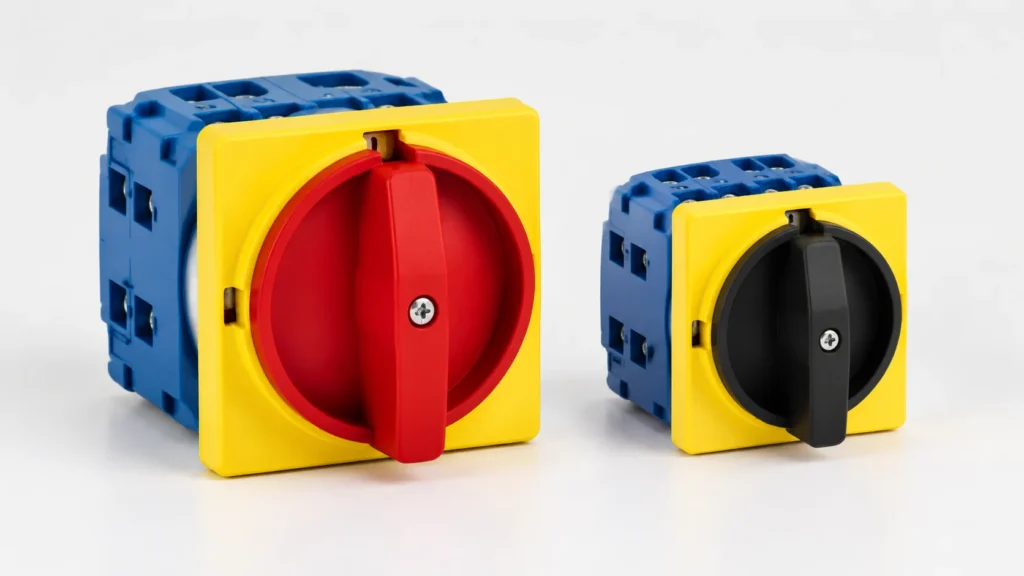
Um seccionador é um dispositivo mecânico que desconecta um circuito de sua fonte de alimentação e mantém uma distância visível enquanto se realiza a manutenção no circuito. Sua função não é proteger o circuito — ele não desarma em caso de sobrecarga ou curto-circuito —, mas tornar o circuito seguro ao toque assim que a falha for sanada.
Essa definição é simples, mas, mesmo assim, a mesma página precisa esclarecer dois equívocos persistentes. O primeiro é que um isolador substitui um disjuntor; isso não é verdade. O segundo, que é mais grave, é que todo isolador é incapaz de interromper a corrente. Alguns são, outros não, e a diferença está indicada na categoria de utilização, e não no nome que consta na caixa.
O que um seccionador faz — e o que ele não faz
Um isolador proporciona isolamento: uma interrupção física em cada condutor, em um ponto visível ou claramente identificado, que possa ser bloqueada enquanto uma pessoa trabalha a jusante. Ela não oferece proteção: sem desligamento térmico, sem desligamento magnético, sem detecção de fuga à terra.
Essas são duas funções diferentes e, muitas vezes, são desempenhadas por dois dispositivos distintos no mesmo painel. A tabela deixa essa distinção clara, pois um painel que depende de um isolador para proteção não possui proteção alguma.
| Dispositivo | Isolados | Corrente de carga dos freios | Limpa uma falha |
|---|---|---|---|
| Isolador (AC-20) | Sim, quebra visível | Não | Não |
| Interruptor-seccionador (AC-21 a AC-23) | Sim, quebra visível | Sim, quanto à sua classificação | Não |
| Interruptor-seccionador com fusível | Sim | Sim | Sim, perto do fusível |
| MCB / MCCB | Apenas como subproduto | Sim | Sim |
| RCD / RCBO | Apenas como subproduto | Sim | Fuga à terra e sobrecorrente em um RCBO |
A consequência prática: é instalado um isolador a montante ou a jusante do dispositivo de proteção, e não em seu lugar. Se o isolador estiver a montante, ele também isola o dispositivo de proteção, que é exatamente o que um eletricista de manutenção geralmente deseja.
AC-20 ou AC-23: a classificação que determina o que ele pode fazer
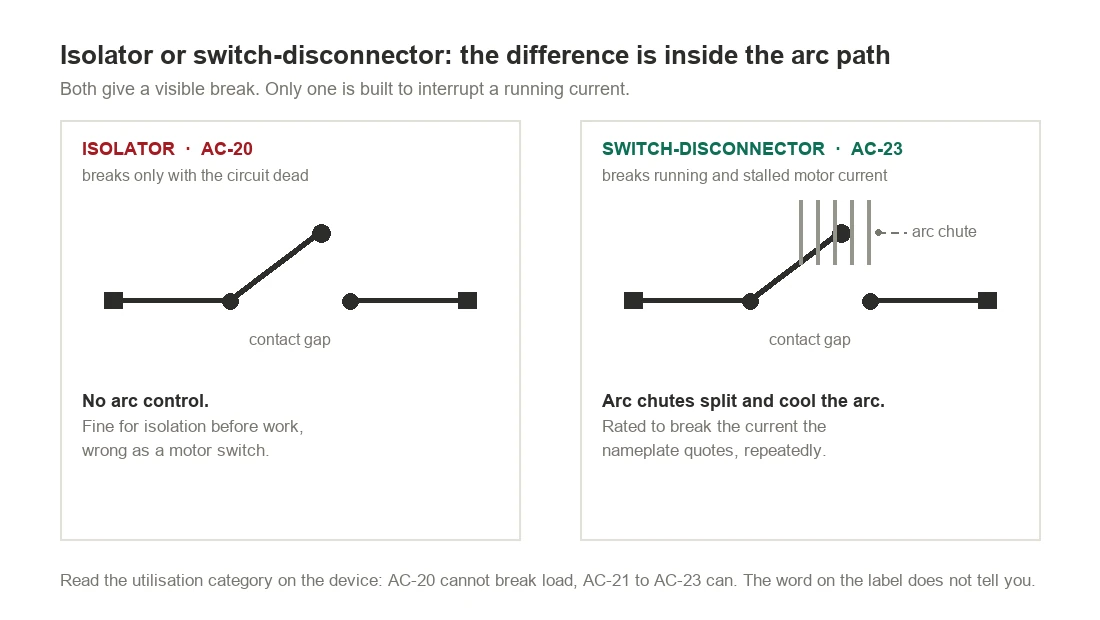
Essa é a parte em que a maioria das descrições de um seccionador erra. Um isolador com classificação AC-20 não possui controle de arco e deve ser acionado somente quando o circuito já estiver desligado. Um seccionador com classificação AC-21, AC-22 ou AC-23 é projetado para interromper uma corrente em circulação e, frequentemente, possui condutores de arco para realizar essa função.
| Categoria | O que pode quebrar | Dispositivo típico |
|---|---|---|
| AC-20 | Sem carga ou com carga insignificante | Isolador simples, execução aberta, sem canaletas de arco |
| AC-21 | Carga resistiva, incluindo uma leve sobrecarga | Interruptor-seccionador para aquecimento e iluminação |
| AC-22 | Carga mista resistiva e indutiva | Chave-seccionadora em rede de distribuição mista |
| AC-23 | Carga do motor, incluindo um motor em calado | Seccionador-desconectador para motores, a opção mais comum para bombas e sistemas de climatização |
Portanto, a afirmação “um isolador não pode interromper a corrente de carga” é verdadeira para dispositivos AC-20 e falsa para os AC-23. Ambos são comercializados como interruptores-isoladores. A categoria indicada na placa de identificação é a única resposta confiável e é a primeira coisa a ser verificada ao substituir um dispositivo em um painel já instalado.
Isso é importante nos dois sentidos. Instalar um isolador AC-20 onde o original era AC-23 significa que, eventualmente, alguém o abrirá sob carga, e os contatos produzirão arco elétrico e sofrerão corrosão por arco. Instalar um dispositivo AC-23 onde foi especificado AC-20 custa mais, mas é seguro — é o erro mais barato dos dois.
Isolador, chave de isolamento, seccionador: três nomes, um único dispositivo
O mesmo dispositivo possui três nomes, dependendo de onde a especificação foi redigida. “Isolador” e “interruptor de isolamento” são os termos britânicos, “interruptor de desconexão” é o termo americano, e “interruptor-seccionador” é o termo utilizado na norma IEC 60947-3 para a versão que também pode interromper a corrente de carga.
Isso é importante quando você está comprando com base em um desenho que indica “interruptor de isolamento” e um catálogo que lista apenas isoladores. Eles pertencem à mesma categoria de produto; o que precisa corresponder é a classificação, não o termo. Um interruptor de isolamento com classificação AC-20 e um isolador com classificação AC-20 são intercambiáveis. Um interruptor de isolamento com classificação AC-23 e um isolador AC-20 não são, mesmo que ambos sejam descritos da mesma forma na parte da frente de uma página do catálogo.
Vale a pena diferenciar dois termos relacionados. Um “interruptor principal” é um isolador que isola toda a instalação, e não apenas um circuito, enquanto um “interruptor de segurança” é um termo genérico que pode se referir tanto a um isolador quanto a um botão de parada de emergência. Nenhum dos dois indica qual é a corrente máxima que o dispositivo pode suportar — e é esse valor que determina se ele resistirá ou não.
Os poloneses e os neutros
Um isolador de três pólos desliga as três fases. Um isolador de quatro pólos desliga as três fases e o neutro, e o quarto pólo não é uma mera formalidade.
Quando o neutro é distribuído e a instalação possui mais de uma fonte — um gerador, um no-break, uma segunda linha de alimentação —, deixar o neutro sem comutação significa que ele permanece conectado mesmo quando as fases estão isoladas. Qualquer pessoa trabalhando a jusante continua, então, conectada a um neutro que pode estar em um potencial acima do terra, e a proteção contra falha à terra na outra fonte perde sua capacidade de discriminação. Desligar o neutro elimina ambos os problemas.
Em um circuito monofásico, um dispositivo de dois pólos (fase e neutro) é o mínimo necessário, que é o caso de um isolador doméstico de dois pólos. Em um circuito de motor trifásico sem neutro, três pólos são suficientes e um quarto é desnecessário.
Onde você realmente encontra um seccionador
Cinco situações representam a maior parte das instalações, e vale a pena diferenciá-las, pois os requisitos variam.
Machine isolation. A lockable switch-disconnector on or beside the machine, so that maintenance can be carried out with the machine provably dead. This is the application the standards care most about: a visible break, a padlock facility and a handle that indicates position unambiguously.
Pumps, fans and HVAC. A local isolator next to the motor, so that the plant can be worked on without walking to the main board. The rating is usually AC-23 because the load is a motor, and the enclosure is usually IP65 because plant rooms are wet. The selection logic for this case is covered in Como escolher um isolador rotativo para bombas e sistemas de climatização.
Domestic air-conditioning and water heating. The outdoor double-pole switch with a neon, rated around 20 A and IP66, is the device most homeowners mean by “isolator switch”. It is a genuine isolator, but it is a consumer product with a consumer rating and it does not transfer to industrial loads.
PV and battery systems. A DC isolator is a different problem: direct current has no zero crossing, so the device must be rated for DC at the system voltage. An AC-rated isolator used on a DC string is a fire risk, not a compromise.
Distribution boards. An incoming isolator gives the board a single point of isolation for the whole installation. Here it is often combined with the main switch, and the fuse or breaker downstream provides the protection.
How to Choose One
- Establish the current. Continuous load current, not the rating of the upstream breaker. Then check what the switch has to break: if it will be opened under load, the category matters as much as the current.
- Check the category. Motor loads want AC-23. Resistive distribution can use AC-21 or AC-22. Pure isolation can be AC-20, but only if nobody will ever open it on load.
- Count the poles. Three phases plus a distributed neutral means four poles. Single-phase means two.
- Decide the enclosure. Open execution inside a panel, an enclosed version on a wall, or a DIN-rail modular device in a board. The IP rating follows the location: IP65 or better outdoors and in plant rooms.
- Confirm the lock-off. A padlockable handle in the off position, and a door interlock if the switch controls access to a panel. These are options on many ranges and are the items most often left off the order.
- Confirm the short-circuit protection is elsewhere. An isolator does not clear a fault. The fuse or breaker ahead of it must be rated to protect both the cable and the switch.
Step six is where installations fail inspection. A switch-disconnector has a rated short-circuit making capacity, but it does not have a trip. Without upstream protection the whole arrangement has no fault clearing at all.
Installation and Lock-Off
Most isolator problems are installation problems, and they fall into four groups.
The break is not visible or not indicated. The point of an isolator is that a person can see, or positively confirm, that the circuit is open. A device mounted so that the contact position cannot be checked defeats the purpose, and a handle that can be left between positions is worse than no indicator at all.
The handle cannot be locked. Lock-off during maintenance is the reason the device exists. A handle without a padlock facility forces the maintenance team to lock something else, which usually means locking nothing.
The terminals are not torqued. A loose terminal on an isolator carrying continuous current will run hot long before it fails. Use the torque figure on the device, and re-check after the first load cycle on a new installation.
Sources are not labelled. On a panel with more than one supply, an unlabelled isolator is a hazard rather than a safety device. Label at the switch, and record the isolation point in the switching schedule.
For the wiring side — terminal arrangement, the order of conductors and the earth connection — the three phase isolator switch wiring diagram works through a typical installation step by step.
Mistakes That Come Up Repeatedly
- Treating the isolator as protection. It has no trip unit. Installing one without upstream protection leaves the circuit unprotected.
- Assuming every isolator is load-break. AC-20 devices are not, and opening one on load damages the contacts.
- Leaving the neutral unswitched on a multi-source installation. The phases are isolated; the neutral is not.
- Using an AC isolator on a DC string. The DC rating is a separate figure and is much lower at the same voltage.
- Ordering an enclosed version for a panel build. Above roughly 200 A the switch belongs inside a purpose-built panel where the busbar work and door interlock can be engineered together.
PERGUNTAS FREQUENTES
What is the difference between an isolator switch and a circuit breaker?
An isolator provides a visible break and isolates a circuit for maintenance; it does not trip on overload or short circuit. A circuit breaker does both switching and protection. Panels normally need both, not one or the other.
Can an isolator switch be switched under load?
Only if it is rated for it. A switch-disconnector rated AC-21, AC-22 or AC-23 can break the current it is rated for; an isolator rated AC-20 cannot and is intended for no-load operation only.
Do I need a 3-pole or 4-pole isolator switch?
Three poles for a three-phase circuit with no neutral. Four poles where the neutral is distributed, and always where there is more than one source, so that the neutral is isolated with the phases.
Does an isolator switch need a fuse?
The isolator itself does not, but the circuit does. Short-circuit protection must be upstream of the isolator, either as a separate device or as a fused switch-disconnector that combines both functions.
What IP rating does an isolator switch need?
IP65 or better for outdoor and plant-room locations, IP54 for a covered indoor position, and IP40 is only acceptable inside an enclosure. The rating applies to the assembled device with its gasket in place.
Can I use a domestic isolator switch on a machine?
No. Domestic isolators are typically 20 A double-pole devices with a consumer rating. A machine needs a switch-disconnector rated for the motor load at AC-23, with a lockable handle and a visible break.
Why does my isolator switch have four terminals instead of two?
Because it is a double-pole device: live and neutral are both switched. That is the normal arrangement for a single-phase isolator, and it is what allows the circuit to be fully isolated rather than just disconnected from the live conductor.
How often should an isolator switch be operated?
Operate it through a full cycle at every scheduled maintenance interval and record the result. Contacts that never move can stiffen or oxidise, and an isolator that has not been operated for years may not open cleanly when it is needed.
Isolation First, Protection Second
The rule that resolves most confusion is simple: isolate with the isolator, protect with the protective device, and never expect one to do the other’s job. Once that is fixed, the remaining decisions are current, category, poles and enclosure — and the category is the one that decides whether the device survives being operated under load.
The switch-disconnectors we build are rated to AC-23 for motor duty and are available with lockable handles, door interlocks and auxiliary contacts. They sit in the LW30 rotary isolator range e o Série LW40, with the wider selection on the páginas sobre chaves rotativas e isoladores. If you already have a device and only need to know what it can break, the Guia de seleção de tipos de interruptores rotativos explains how to read the category off the nameplate.
Send us the load, the supply arrangement and where the switch will be mounted, and we will come back with the category, the pole count and the enclosure rather than the nearest catalogue item.