







Have you ever looked at a control panel and wondered how one ammeter can “magically” show the current of multiple feeders? That magic is usually an ammeter rotary switch. It lets you route current signals (often from current transformers) to a single meter so you can check different circuits without installing a meter for each one.
If you’re specifying a new panel, retrofitting an existing switchboard, or comparing components for an industrial project, this article will help you understand what an ammeter rotary switch does, which types matter, and how to choose one that’s safe, durable, and easy to service.
What an ammeter rotary switch actually does
An ammeter rotary switch is a multi-position selector that connects an ammeter (analog or digital) to different current inputs. In many installations, those inputs come from current transformers (CTs), which scale high line currents down to a safer secondary current (commonly 1A or 5A).
When you turn the knob, you’re selecting which circuit’s current is displayed. That means you get:
- One meter monitoring multiple lines
- Faster troubleshooting during commissioning and maintenance
- Lower panel cost and less wiring than “one meter per feeder”
If you’re thinking, “So it’s basically a channel selector for current,” you’ve got it. The key difference is that CT circuits have safety requirements that normal signal switching doesn’t.
Where you’ll typically use an ammeter rotary switch
You’ll find an ammeter rotary switch anywhere operators or technicians need quick current checks across multiple circuits. Common industrial use cases include:
- Switchboards and distribution panels (incoming, outgoing feeders)
- Motor control centers (MCCs) (motor feeders and groups)
- Generators and ATS systems (phase current verification)
- Compressors, pumps, and process skids (load balancing)
- Solar and energy storage balance-of-system panels (strings/outputs, depending on design)
- OEM equipment where panel space is tight but monitoring is required
In these environments, the switch must handle repetitive operation, vibration, and heat, while maintaining clean contact resistance for accurate readings.
Types of ammeter rotary switches and when each makes sense
Not all selectors are built the same, and the “right” ammeter rotary switch depends on how many circuits you need to measure and how your CTs are wired.
1) Phase selectors vs multi-circuit selectors
- Phase selector (R/Y/B or A/B/C): Often used with a three-phase system to view phase currents one at a time.
- Multi-circuit selector: Lets one meter monitor multiple feeders or loads (e.g., Feeder 1, Feeder 2, Feeder 3…).
2) Break-before-make vs make-before-break (critical for CTs)
For CT secondary circuits, switching behavior matters a lot:
- Make-before-break (MBB): The new contact closes before the old one opens. This helps avoid opening the CT secondary.
- Break-before-make (BBM): The old contact opens first. In CT applications, this can momentarily open the secondary and create dangerous voltage.
In practice, many CT selector designs incorporate shorting contacts to keep the CT secondary safely shorted during switching.
3) Number of positions and poles
You’ll see options like:
- 3-position (often phase-only)
- 4/6/8/10/12-position for multi-feeder monitoring
- Various pole counts to match your wiring (e.g., switching multiple CT secondaries and a common return)
A quick way to think about it: positions determine how many circuits you can select; poles determine how many conductors are switched per position.
4) Panel-mount vs DIN-rail solutions
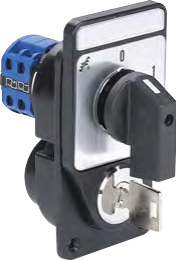
Most are panel-mount rotary selector switches with a door-coupled handle. Some designs integrate with modular systems, but panel mounting remains common for visibility and access.
| Type | Best for | What to watch |
|---|---|---|
| Phase selector (3-position) | Basic three-phase monitoring | Ensure CT-safe switching behavior |
| Multi-circuit (6–12 positions) | Multiple feeders/loads | Position labeling, contact reliability |
| MBB with shorting | CT secondary switching | Reduces risk of open-circuit CT |
| Heavy-duty industrial selector | High vibration/heat panels | Mechanical life, ingress protection |
CT safety: the non-negotiables (and why they matter)
If your ammeter rotary switch will switch CT secondary circuits, safety is not optional. Opening a CT secondary under load can produce very high voltage. That can damage insulation, meters, and—more importantly—put people at risk.
Here’s what you should insist on in CT applications:
- Shorting mechanism or CT-rated design that prevents open-circuit secondaries during switching
- Clear wiring diagrams and terminal markings
- A switching scheme that keeps the CT secondary controlled at all times
If you’re unsure whether your design needs a CT-safe selector, a practical rule is: if CTs are involved, treat the selector as a safety component, not just a convenience part.
No pressure—just the kind of pressure that prevents smoke.
Specifications that determine performance and compatibility
When you compare options, the most important differences are usually in electrical ratings, mechanical durability, and how well the switch fits your panel and wiring approach. A good ammeter rotary switch should match both your system conditions and your maintenance reality.
Electrical ratings to confirm
- Rated insulation voltage and rated operational voltage
- Current rating of contacts (even though CT secondary is low, the switch must be properly rated)
- Impulse withstand and insulation class where relevant
- Compliance needs (often IEC; sometimes UL depending on market)
Mechanical and environmental considerations
- Mechanical life (number of switching operations)
- Operating temperature range
- Vibration resistance for industrial panels
- Ingress protection (especially for dusty or washdown-adjacent environments)
Usability and serviceability details
- Positive detents between positions
- Clear position indexing and label options
- Terminal type (screw clamp, ring lug support, touch-safe design)
- Space behind the door for wiring bend radius
| Spec to check | Why it matters | Typical decision impact |
|---|---|---|
| Switching behavior (MBB/shorting) | CT safety | Often the #1 requirement |
| Number of positions | How many circuits you can monitor | Drives model selection |
| Pole count | How many conductors are switched | Affects wiring complexity |
| Mechanical life | Reliability in daily operation | Impacts maintenance cost |
| Mounting depth | Panel fit | Prevents rework during build |
Wiring and installation tips that prevent headaches later
Even the best ammeter rotary switch can become a problem if it’s wired or labeled poorly. A few practical steps improve safety and troubleshooting speed.
Best practices
- Label every position to match single-line drawings and panel schedules.
- Use consistent CT secondary wiring colors and ferrules.
- Keep CT secondary wiring tidy and secure—loose wires lead to intermittent readings.
- Where required, use shorting terminal blocks in addition to a CT-safe selector to simplify maintenance.
- Verify meter burden and CT sizing so you don’t introduce measurement errors.
Commissioning checks
- Confirm each selector position corresponds to the intended feeder/phase
- Verify no CT secondary opens during switching (based on your design and test procedure)
- Confirm the ammeter reads stable and consistent across positions
If you want to reduce commissioning surprises, align your wiring diagram with the exact selector model early—don’t wait until the panel is already built.
How to evaluate options when you’re buying
Commercial investigation usually comes down to: “Will this component be reliable, compliant, and easy to support for years?” When you compare an ammeter rotary switch across vendors, focus on evidence, not adjectives.
Questions worth asking suppliers
- Is this CT-rated and how is CT safety ensured during switching?
- Can you provide dimensional drawings and terminal layouts?
- What standards does it comply with (IEC/UL as needed)?
- What is the mechanical life rating and test basis?
- Are spare parts (knobs, legends, blocks) available?
If you’re sourcing for an industrial build and want a fast shortlist, you can also send us your panel requirements and request a quote—a simple spec review upfront often prevents costly mismatches later.
When a rotary switch is enough—and when “smart” monitoring wins
A classic ammeter rotary switch is excellent for spot checks. But if you need continuous visibility, alarms, or remote reporting, you may consider complementing or replacing manual selection with:
- Digital power meters with multi-channel inputs
- Smart monitoring via IoT gateways
- Data logging for maintenance and energy management
A useful way to decide:
- If operators only need occasional checks, a selector plus a good meter is efficient.
- If you need trends, alerts, or compliance reporting, smart metering can pay back quickly.
Many industrial panels use both: a selector for quick local verification and a digital system for analytics.
Conclusion
An ammeter rotary switch is a simple component with an outsized impact on panel usability, safety, and cost. When you understand how it selects circuits, how CT secondary safety shapes the design, and which specifications matter most, you can choose a selector that works reliably for years—not just on day one.
Focus on CT-safe switching behavior, the right number of positions and poles, solid mechanical ratings, and practical details like labeling and terminal design. With those fundamentals in place, you’ll be able to evaluate options confidently and select a solution that fits your application, your standards, and your maintenance workflow.
What is the difference between an ammeter and an electric power meter?
An ammeter measures current (amps) only. An electric power meter typically measures multiple values such as voltage, current, power (kW), energy (kWh), power factor, and sometimes harmonics.
Can an ammeter rotary switch be used with a digital power meter?
Yes, in many designs the selector can route CT secondary current to a digital meter input. However, you must ensure the selector is CT-safe and that the meter input configuration matches the CT secondary (1A or 5A).
Do I need a current transformer to use an ammeter rotary switch?
In most industrial applications, yes. CTs allow safe measurement of high currents. Direct-connected ammeters are typically limited to lower currents and require different wiring and protection.
What happens if a CT secondary is accidentally opened?
An open CT secondary under load can generate dangerously high voltage, which may damage equipment and pose a shock hazard. That’s why CT switching should use a CT-rated selector design or a shorting method.
How do I choose between 3-position and 12-position selector switches?
Choose based on how many circuits you need to monitor with one meter. A 3-position selector is common for three-phase current checks. A 12-position selector is common when monitoring many feeders or loads.
Are rotary selector switches accurate for metering?
The switch itself doesn’t “measure,” but poor contacts or incorrect wiring can introduce instability or intermittent readings. Choosing a quality ammeter rotary switch and installing it correctly supports accurate, repeatable measurements.